Courmayeur · Monte Bianco · Aosta Valley · Klaus Polzer · Metering · Freeride · Snowboarding
ExposureThe Meter Is Not Broken: Metering Snow When the Subject Lasts a Second and a Half
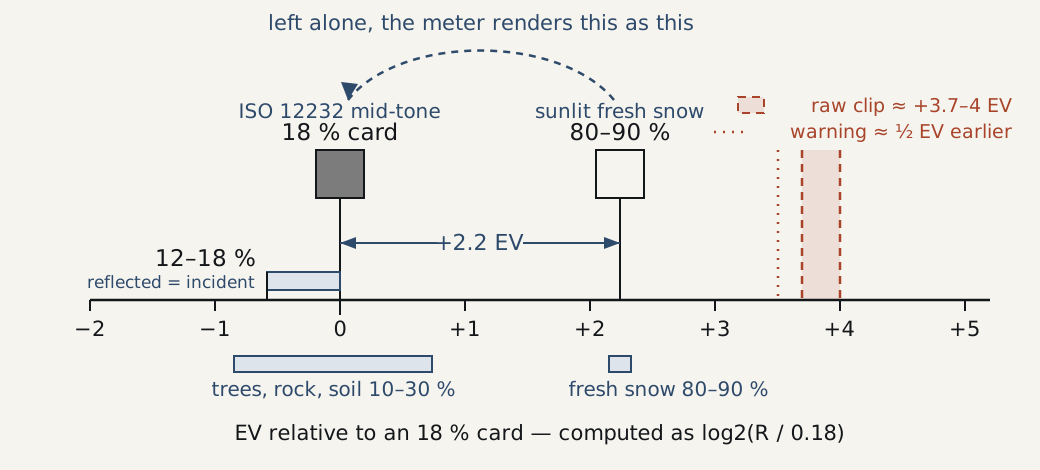
Reflected-light meters do exactly what ISO 2720 and ISO 12232 specify, which is why a snowfield comes back grey — and why the correction is not one number but a range that runs from about +0.3 EV to about +2.2 EV before the light has changed at all.
The advice is the same on every page that answers the question: snow fools the meter, add one to two stops, the snow goes white again. It is not wrong — it is one number standing in for a quantity that moves more than two stops between frames taken thirty seconds apart, and the reason it moves is more useful than the number.
Start with the accusation, because it is false. A reflected-light meter is not fooled by snow and is not making an error. It does what its governing document tells it to do: report the exposure that renders the luminance in front of it as a mid-tone. Hand it a coal cellar and it renders the coal as a mid-tone too. What the surface actually is, no standard specifies; that part is the photographer's.
What the standard actually says
Two documents get collapsed into one, and that is where the folklore comes from. The first is ISO 2720:1974, the guide to product specification for general purpose photographic exposure meters. For a reflected-light meter it ties subject luminance, sensitivity setting and exposure together through a calibration constant written K, and prescribes no value for it — only a range, 10.6 to 13.4 with luminance in candelas per square metre. Canon, Nikon and Sekonic build to 12.5, inside that range; Minolta, Pentax and Kenko build to 14, above its top end. The standard's own wording is not advisory: the constant "may be assigned a value within the limits", latitude that exists so a manufacturer can "declare an optimum value of the constant within the stipulated limits". Two meters a sixth of a stop apart on the same wall, and only one of them inside the limits.
There is no reflectance anywhere in that: K is a constant of luminance, and the 18 per cent figure enters elsewhere. ISO 12232:2019, the standard for digital camera speed ratings, defines exposure index as a reference exposure of 10 lux-seconds divided by the average focal-plane exposure, and notes what that average corresponds to in the world: for an average scene, a mid-tone exposure "approximately equal to the exposure which would be obtained from an 18 % reflectance test card positioned in the scene and illuminated by the main light source."
So the grey card is real, named in a real standard, and not what the meter is calibrated to; it is what the sensitivity rating is referenced to. The two do not quite agree. ISO 12232's conversion from luminance to focal-plane exposure carries a factor of 65/100 for the standard lens model, which puts a K = 12.5 meter at 8.13 lux-seconds against the reference 10 — 0.30 EV darker, 0.14 EV at K = 14, before any snow. Computed from published formulas, not measured.
The card compounds the problem rather than solving it. The reflectance at which a reflected and an incident reading of the same scene agree is πK/C, where C is ISO 2720's incident-light constant — ranges again, 240 to 400 for a flat receptor and 320 to 540 for a hemispherical one. Across the constants actually shipped that ratio lands between about 12 and 18 per cent; across everything ISO 2720 permits, between about 6 and 18. There is no single reflectance the meter "is calibrated to", which is why the folk correction for a grey card carries three different numbers.
How much of the frame is snow
Now the surface. The National Snow and Ice Data Center puts snow's albedo at 80 to 90 per cent of incoming sunlight, trees, plants and soil at 10 to 30. Those two ranges, and the share of the frame each occupies, are the whole of the arithmetic.
They are broadband figures, and a photographic meter is not broadband. Warren Wiscombe and Stephen Warren's 1980 spectral model in the Journal of the Atmospheric Sciences put pure snow at 96 to 99 per cent albedo in the visible, falling steeply into the near infrared, and found impurities at a part per million by weight pulling that figure down by 5 to 15 per cent. In the meter's band, clean fresh snow is brighter than the quoted albedo and dirty spring snow is not.
Take snow at 0.85 and everything else at 0.15, both from the NSIDC ranges, and compute what places the scene where an 18 per cent card in the same light would sit — log₂(R̄/0.18), R̄ being the area-weighted mean reflectance.
| Snow, as a share of the frame | Mean reflectance | Compensation |
|---|---|---|
| 100 % | 0.85 | +2.2 EV |
| 80 % | 0.71 | +2.0 EV |
| 60 % | 0.57 | +1.7 EV |
| 40 % | 0.43 | +1.3 EV |
| 20 % | 0.29 | +0.7 EV |
| 10 % | 0.22 | +0.3 EV |
Computed by Cold Light from reflectance ranges published by the National Snow and Ice Data Center (snow 80–90 %, vegetation and soil 10–30 %), taking 0.85 and 0.15. Reference mid-tone is ISO 12232:2019's 18 % card; add about 0.6 EV throughout if the reference is taken at the 12 % bottom of the shipped band instead.
That table explains both halves of the folklore. A frame of nothing but sunlit snow needs more than two stops, well past what the ranking pages say; a frame with a rider, a rock band and a stand of larch needs about one. "+1 to +2" is not a physical constant, it is a description of the frames most people take.
Which meter the table describes
There is a second reason the folklore survives, and it is the assumption most likely to be wrong on the camera in a reader's hands. Everything above describes a meter that reports the luminance in front of it and nothing else — a spot reading, a centre-weighted reading, a whole-frame average. That is not what the general-purpose mode on any of these bodies does.
Nikon's own reference guide for the Z 8 describes matrix metering as a mode in which "the camera meters a wide area of the frame and sets exposure according to tone distribution, color, composition, and distance for results close to those seen by the naked eye". Canon's product manual for the EOS R5 Mark II calls evaluative metering the "General-purpose metering mode suited even for backlit subjects" and says "the camera adjusts the exposure automatically to suit the scene". Sony's help guide for the ILCE-1 describes its Multi mode as measuring "light on each area after dividing the total area into multiple areas" and determining "the proper exposure of the entire screen". Nikon has said in its own words where the judgement comes from: its 2009 release for the D3S describes the camera "using highlight analysis from the Scene Recognition System and then carefully selecting from a database containing information from over 30,000 actual shooting situations".
Not one of those sentences says mid-tone. ISO 2720's reflected-light relation maps a single measured luminance to a single exposure through K; a mode that weights the frame by tone distribution, colour, composition and distance is not reporting a single luminance, and by its makers' own account is not trying to. It departs from the standard's device by design. The departure will be largest on exactly the scene under discussion, because a bright, high-key field is where rendering the measured luminance as a mid-tone gives the result nobody wants, and "results close to those seen by the naked eye", in Nikon's phrase, is a different target. How much of the correction the camera has already applied, no maker publishes.
So the table above is a table for a spot or an averaging reading, and it is not a table for a matrix one. Added on top of a matrix reading it risks double-counting by an amount nobody has quantified in public — which would account for a rule of thumb that sometimes works and sometimes blows the snow out, though no source read here tests that. Nothing follows about which mode is better. What follows is that the mode is the first term and the compensation is the second: a figure in EV means nothing until the reading it is being added to has been identified, and matrix and spot on the same snowfield are not the same reading.
A second and a half
Everything above assumes the photographer has time. On a slope that assumption fails.
Measured skiing speeds exist. Carus and Castillo, publishing in PLOS ONE in 2021, tracked 421 more-skilled adult skiers on groomed red runs by GPS at a mean actual maximum of 54.07 ± 15.27 km/h; Brunner, Ruedl, Kopp and Burtscher, in the same journal in 2015, radar-gunned 416 adult skiers at 48.2 ± 14.3 km/h. Both are pisted figures; no source read here quantifies freeride speeds.
Take 40 to 55 km/h — 11.1 to 15.3 metres per second — and do the geometry in metres rather than millimetres. On the 36 × 24 mm frame that this publication's companion article on focal length and distance works from, the width the frame covers at the subject is 36 × D / f, distance in metres against focal length in millimetres. A rider and skis span near two metres; hold that at an eighth of the frame width and the frame is sixteen metres wide at the subject, which is crossed in 1.0 to 1.4 seconds.
The width is the invariant, and the focal length is not in it. Sixteen metres is what a 24mm lens covers from about 10.7 m and what a 200mm covers from about 88.9 m: the distance scales with the focal length and the seconds do not move at all. What does move them is the framing. At the companion article's tighter standard — a 1.8 m rider held at one third of the frame height, which is 24mm from 5.4 m or 200mm from 45 m — the frame is 8.1 m wide and the rider is through it in 0.5 to 0.7 seconds. The loose framing is the generous case, and it is the one costed below.
Against that clock, place the rituals.
Spot metering first. The same Nikon guide for the Z 8 specifies that spot metering reads "a circle with a diameter of 4 mm/0.16 in. (equivalent to approximately 1.5% of the frame)". Metering and recomposing means holding that 1.5 per cent on a chosen surface, locking, recomposing and firing, on a subject crossing at fifteen metres per second. The technique is sound; the budget is not. A grey card is worse: it must sit in the same light as the subject, which at 200mm is the better part of ninety metres out on a slope the photographer has deliberately not stood on. An incident reading fails identically.
Bracketing looks affordable and is not. Nikon's guide lists continuous high-speed release at 10 to 20 frames a second on the Z 8, and frame-capture modes at 15, 30, 60 and 120 where, in Nikon's own text, "Pictures are recorded in JPEG format". A 1.2-second window at 20 frames a second is about twenty-four frames; a three-frame bracket at ±1.5 EV turns those into eight instants of the trick and spends the other sixteen at the wrong exposure. And the rates fast enough to make that painless stop producing a raw file at all — which is where the raw-headroom argument below quietly stops applying.
Two illuminants, one shutter
The remaining thing that moves the number is not the frame's composition at all: a snow slope in the Alps is routinely lit by two sources at once, and only one exposure gets set.
Snow in sun is lit by the sun plus the sky; snow in open shade is lit by the sky, plus whatever the sunlit snow around it bounces back — a term that is large in a snow basin and small on an isolated shaded slope. The diffuse-ratio statistics that get quoted at this point are the wrong instrument for it, because a diffuse ratio is measured on a horizontal surface and a slope is not horizontal: a face turned towards the sun takes the beam near its own normal and so receives more than any horizontal surface at the same instant. The gap has to be worked for tilted planes or not at all.
This publication's companion article on the two colour temperatures of a single slope works it that way, and its model is the one used here. A clear early-March day is modelled at 900 W/m² direct-normal and 100 W/m² diffuse-horizontal irradiance under an isotropic sky, with two opposed 40° faces at Courmayeur's latitude on 5 March, when solar noon elevation is 38.2° on the NOAA Solar Calculator's implementation of Jean Meeus's algorithms. The south face takes the beam 12° off its normal; the north face takes none at all. The gap between them is 2.7 stops where the shaded face stands in a basin of snow at the National Snow and Ice Data Center's 0.85 albedo, and 3.3 stops over dark ground — the difference being the bounce, which in the snow case supplies about two fifths of everything the shaded face receives. Modelled, not metered: nobody at this desk has put a meter on either face, and the range is the honest output rather than the single number.
Run that through the same arithmetic. Snow 2.7 stops down reads as about 0.13 in sunlit-equivalent terms against 0.85 in the sun, so a frame that is entirely snow, half sunlit and half in a ridge's shadow, averages about 0.49 rather than 0.85: the compensation drops from +2.2 EV to about +1.4 EV, and the shaded half goes correctly dark, half a stop under the mid-tone. Take the bounce away and almost nothing happens to the compensation — at the 3.3-stop end the mean is 0.47 and the figure is still +1.4 EV — because a region seven to ten times darker than the rest cannot move an average much. Where the bounce shows is inside the shaded half, which sits half a stop under the mid-tone in the basin and a full stop under it without it. Expose instead so that something in the shade — a rider's face inside a helmet — lands where the sun would have put it, and the whole frame moves by the illumination ratio: +4.2 to +4.7 EV, which places the sunlit snow 5.0 to 5.5 EV above the mid-tone. That is past the point at which an in-camera JPEG holds texture and past the raw ceiling measured below. Two frames, one slope, a second apart, and the whole illumination ratio between them.
What replaces the ritual
Nothing on that list can be executed in 1.2 seconds. What is left is decided before the rider drops, plus one continuous display. A manual exposure set from the sunlit snow and held across the run is the base case: the light does not change during the run, only the framing.
Zebra display is the continuous instrument. Sony's help guide for the ILCE-1 describes it plainly: a zebra pattern "appears over part of an image if the brightness level of that part meets the IRE level that you have set", with selectable levels from 70 to 100+, and separate guidance for using a range to confirm exposure or a floor to catch overexposure. Set the floor where the rendering stops holding snow texture and the display reports on the surface itself, every frame, at no cost in time.
Highlight-weighted metering is a different starting point, not an answer, and its own manufacturer says so. Nikon's Z 8 guide describes it as assigning "the greatest weight to highlights"; Nikon Professional Services' note for the D810 says the mode's "first priority is to reduce washout" and tells the user to "use exposure compensation to achieve the desired result". It moves the reference to the brightest region, and still needs a decision about where white sits.
Raw headroom is the last of it, and the reason "correct" differs for raw and JPEG: the camera's histogram is computed from the embedded JPEG, after white balance, tone curve and saturation. The RawDigger team, in a technical note published in March 2012, measured a Canon EOS 5D Mark II at ISO 200 and found raw highlight headroom of "15.5 times, or slightly less than 4 stops" — under a very bright, very clear blue sky at 8,800 to 9,900 K, with the same note putting normal daylight at about 3.7 stops. The overexposure warning fired roughly half a stop early at standard contrast and saturation, and came within 0.3 EV only with the white balance multipliers neutralised and contrast and saturation at maximum; at normal contrast it fired late instead. One body, 2012 — and none of it applies to the JPEG-only high-speed modes.
Three days under Monte Bianco
This is the condition the Courmayeur contest was built around. Click on the Mountain's own archived schedule for 2015 set a team briefing at the Sunny Side café on Tuesday 3 March at 20:30, shooting on Wednesday 4, Thursday 5 and Friday 6 March, and the award for the best photographic book on Saturday 7 March at the Jardin de l'Ange. The terrain was not the photographers' to choose: the event's own archived news page records the heliski spots drawn by lot at that briefing, from four Mont Blanc itineraries — Aiguille de l'Aigle, Col des Pyramides, Lex Blanche and Mont Fortin — and the teams met their riders and guides for the first time that evening.
Writing for skiing.de on 8 March 2015, a correspondent bylined Teddy reported the teams working Wednesday under cloud cover and meeting sun on the Thursday, with wind strong enough that the upper terrain was closed and all four were pushed below the treeline. He wrote of the helicopter day as forecast rather than seen; the event's own news page records that it went ahead in sun and calm, with thirty minutes of flying to each team. The photographers were Klaus Polzer, Guy Fattal, HIISHII and Lorenzo Rieg.
Inside forty-eight hours, then, the same four photographers shot a diffuse overcast with almost no directional light and hard sun on a wind-scoured slope with rock and trees in the frame — two days whose honest compensation differs by more than a stop and a half.
The meter is not broken, and neither is the advice. What is broken is the idea that a scene-dependent quantity can be published as a constant, and added to a reading whose mode nobody has stated. The number is set by three things visible before the rider drops — how much of the frame is snow, whether the sun reaches it, and whether the exposure protects a highlight or a face — and by one that is not, which is where the rendering stops holding texture. The first three can be settled standing still; the fourth is what the zebras are for.
Something here wrong or incomplete? Corrections are published, dated and kept: /corrections/.