Courmayeur · Cresta d’Arp · Val Veny · Ghiacciaio del Toula · Aosta Valley · Tero Repo · Roberto Bragotto · Freeride
The SlopeDistance Decides the Lens: Why a Forty-Degree Face Reads Flat at 200mm
Works the angular arithmetic of a forty-degree face and finds that the terrain sets the subject distance, the focal length follows from it, and the same slope photographed twenty degrees off the fall line draws at sixteen degrees.
Ask a search engine what lens to use for ski photography and it answers with a shopping list. That is a commercial question wearing the clothes of a technical one. The question that a photographer standing on a snow slope actually has is geometric, and it runs the other way: the terrain and the safe standing ground decide how far from the rider a person can be, the subject distance follows from that, and the focal length is simply whatever holds the rider at the size the picture needs from there. The lens is the last term in the equation. It is not a choice so much as a consequence, and it can be read off a slope with arithmetic small enough to do on a chairlift.
The frame never changes size
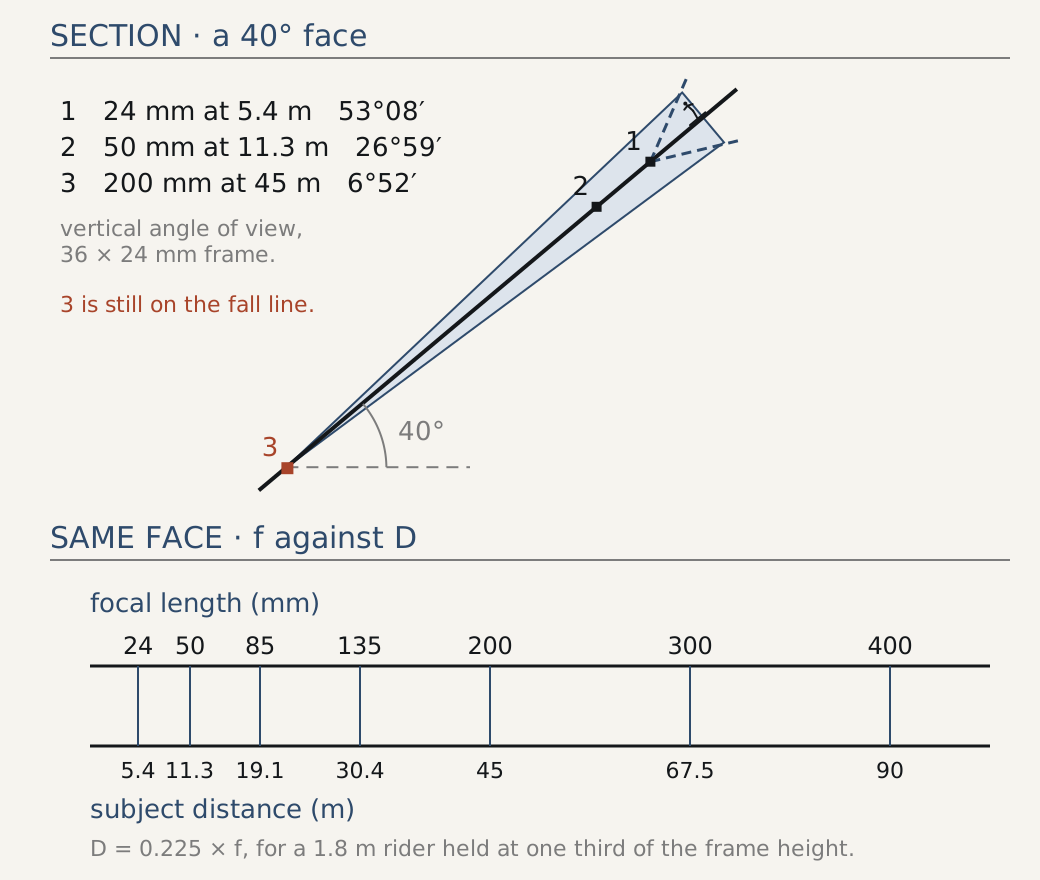
A rectilinear lens of focal length f renders a subject of height h at distance D as a fraction fh / HD of the frame height, where H is the height of the frame — 24 mm on the 36 × 24 mm format, in landscape orientation. Fix the framing and the relation collapses to a straight line. Holding a 1.8 m rider at one third of the frame height gives D = 0.225 × f, distance in metres, focal length in millimetres.
| Focal length | Subject distance | Vertical angle of view |
|---|---|---|
| 16 mm | 3.6 m | 73°44′ |
| 24 mm | 5.4 m | 53°08′ |
| 50 mm | 11.3 m | 26°59′ |
| 85 mm | 19.1 m | 16°04′ |
| 135 mm | 30.4 m | 10°10′ |
| 200 mm | 45.0 m | 6°52′ |
| 300 mm | 67.5 m | 4°35′ |
| 400 mm | 90.0 m | 3°26′ |
Computed for a rectilinear lens on a 36 × 24 mm frame in landscape orientation, subject height 1.8 m at one third of frame height. Cross-checked against manufacturers' published figures: Nikon gives the NIKKOR Z 70-200mm f/2.8 VR S a diagonal angle of view on the FX frame of 34°20′ at 70 mm and 12°20′ at 200 mm; Canon gives the RF 100-500mm F4.5-7.1 L IS USM a vertical angle of 14° at 100 mm and 2°45′ at 500 mm.
The first consequence of that table demolishes the folk version of the argument. If the rider is held at one third of the frame, the frame covers 5.4 m of subject height and 8.1 m of subject width at every distance in the column. A five-metre air fills the same nine-tenths of the frame at 24 mm from 5.4 m as it does at 200 mm from 45 m. Wide lenses do not make airs bigger. Nothing about the rider changes at all. What changes is everything around the rider.
The measure of that change is the depth gradient: how fast apparent size falls off with distance behind the subject. Apparent size goes as 1/D, so three metres of depth — roughly the gap between a take-off lip and the snow immediately behind it — costs 45 per cent of apparent size at 3.6 m, 21 per cent at 11.3 m, 6 per cent at 45 m and 3 per cent at 90 m. Close in, the lip is huge and the landing is small and the eye reads a drop. From across the bowl the lip and the landing are within a few per cent of the same size, and the eye reads a flat band of snow with a person on it. That is the whole of what "compression" means, and it is a property of where the camera stood, not of the glass.
Two horizons, forty degrees apart
There is a second effect, and it is the one that answers the headline. A planar slope has its own horizon. Every direction lying in the surface of the slope — the fall line, the traverse, everything between — converges on a single line in the image, and that line is where the snow surface would appear to end if the slope ran on for ever. For a camera held square to gravity and pointed straight up or down the fall line, the slope's horizon is horizontal in the frame and sits exactly one slope angle away from the true horizon — above it looking up the fall line, below it looking down. On a 40° face those two lines are 40° apart. On a 38° face, 38°.
Everything the eye uses to judge pitch lives in the gap between them. Take one away and the frame contains a surface with no stated relationship to gravity, which is to say a wall, or a floor, depending on what the viewer decides to believe.
A frame can carry both lines only if its vertical angle of view is at least as large as the slope is steep. That threshold is worth writing down, because it is a hard number and it is not a matter of taste.
| Slope | 36 × 24 mm, landscape | 36 × 24 mm, portrait | Nikon DX, landscape | Micro Four Thirds, landscape |
|---|---|---|---|---|
| 35° | 38 mm | 57 mm | 25 mm | 21 mm |
| 38° | 35 mm | 52 mm | 23 mm | 19 mm |
| 40° | 33 mm | 49 mm | 22 mm | 18 mm |
| 45° | 29 mm | 43 mm | 19 mm | 16 mm |
Longest focal length whose vertical angle of view equals the slope angle, computed for frame heights of 24 mm, 36 mm, 15.7 mm and 13 mm. Nikon publishes a diagonal angle of view of 8° at 200 mm on the DX frame for the NIKKOR Z 70-200mm f/2.8 VR S, which is consistent with the 23.5 × 15.7 mm DX frame assumed here; the vertical angle of view at that focal length on that frame is 4.5°.
At 200 mm the vertical angle of view on the larger frame is 6°52′. The frame is one-sixth as tall as the geometry it is being asked to describe. The true horizon and the slope's horizon are both outside it, and no amount of light or timing puts them back. That is why a forty-degree face reads flat at 200 mm, and it is not a defect of the lens.
Twenty degrees off the fall line
The gap between the two horizons is only one of the two channels through which pitch reaches a viewer. The other is the tilt of the slope's horizon in the frame, and it depends on where the camera stands around the slope rather than how far away.
Let ψ be the angle between the direction the camera is looking and the fall line, measured in plan: ψ = 0° is looking straight up or down the fall line, ψ = 90° is looking straight across the slope. For a level, unrolled camera, the slope's horizon is drawn in the frame at an angle of arctan(tan θ × sin ψ) from the image horizontal, where θ is the true slope angle. The two channels trade off exactly: on the fall line all of the information sits in the vertical gap and none in the tilt, and side-on it is the reverse.
| Angle off the fall line | Apparent pitch, 38° face | Apparent pitch, 40° face |
|---|---|---|
| 0° | 0° | 0° |
| 10° | 7.7° | 8.3° |
| 20° | 15.0° | 16.0° |
| 30° | 21.3° | 22.8° |
| 45° | 28.9° | 30.7° |
| 60° | 34.1° | 36.0° |
| 90° | 38.0° | 40.0° |
Computed from arctan(tan θ × sin ψ) for a level camera with the image horizontal parallel to true horizontal. Rolling the camera adds or subtracts directly from the figures in the last two columns.
A forty-degree face photographed twenty degrees off the fall line draws at sixteen degrees. Nothing has gone wrong. The picture is a correct projection of the slope, and it is correctly reporting an angle nobody wants. Only at ψ = 90°, side-on and level, does the frame draw the pitch at its true value — which is why the honest steep-skiing photograph is nearly always taken from the side of the line, and why the same slope on the same afternoon can produce a photograph that looks vertical and one that looks like a car park.
The two channels are not equally robust, and the difference decides what has to be in the frame. On the fall line the pitch is the gap between two lines that stay parallel, and rolling the camera turns both of them together and leaves the gap intact; the only requirement is a frame tall enough to contain it, which is the threshold in the table above. Side-on, the pitch is one line's tilt against true horizontal, so the frame has to state where level is — the true horizon, or something in it a viewer knows to be level or plumb — and five degrees of roll is five degrees on or off the reported pitch. What moves between the two is not the steepness of the slope. It is which line is carrying it, and what else has to be included before a viewer can find it.
What the Courmayeur ground allows
Both results are academic until the terrain gets a say, and terrain is where the argument stops being about optics. The Regione Autonoma Valle d'Aosta publishes the Courmayeur Mont Blanc figures on its own tourist database: a ski area running from 1,224 m in the town to 2,755 m at Cresta d'Arp, with Plan Chécrouit at 1,704 m and Pré de Pascal at 1,912 m, thirty-three marked runs over 43 km and around 100 km of terrain in total. The same database, published by the Regione Autonoma Valle d'Aosta, describes the off-piste descent of the Ghiacciaio del Toula as 12 km and 2,082 m of vertical, reached through the Canale del Tedesco — 200 m at a gradient of 45 degrees, which the region states is reserved for expert skiers accompanied by an alpine guide, on a route that is neither marked nor patrolled and where a transceiver, shovel and probe are required. Slope angles at that scale are also mapped: the Regione Autonoma Valle d'Aosta's Geoportale SCT publishes a carta delle pendenze, a slope map derived from the regional digital terrain model, under a CC BY licence.
AINEVA, the interregional body that coordinates Italy's avalanche bulletins, fixes the vocabulary those numbers sit in. Its glossary defines a steep slope as terrain inclined at more than 30°, whatever its shape, and bands the ground above that: 30° to 35° steep, 35° to 40° very steep, above 40° extremely steep. A great deal of the terrain that produces the photographs sits in the last two bands, which is the same as saying that the geometry which makes a face worth photographing is the geometry AINEVA is warning about.
That is where the focal-length question turns into a standing question. Backing away from a rider on an open face to reach 45 m does not leave the slope; it only moves further down the same fall line, still under everything above. The Aosta Valley snow and avalanche bulletin — issued by the Regione Autonoma Valle d'Aosta through its Dipartimento protezione civile, with Fondazione Montagna Sicura, the non-profit foundation based at Villa Cameron in Courmayeur, supporting its drafting and issuing and coordinating the region's glacier monitoring through the Cabina di regia dei ghiacciai valdostani — is the standing institutional source for whether that ground is loaded on a given morning; a lens specification is not. Moving sideways is what raises ψ, and raising ψ moves the pitch out of the vertical gap and into the tilt of the slope's horizon. That much is arithmetic, and it is also the limit of it: ψ says where the camera is pointing from, and nothing whatever about what the ground it is pointing from will do. The distances are small against the ones the snow works in. Twenty degrees off the fall line at the 45 m station is about fifteen metres of sideways step, and Jürg Schweizer and Martina Lütschg of the Swiss Federal Institute for Snow and Avalanche Research SLF, analysing ten years of Swiss avalanche data in Cold Regions Science and Technology in 2001, report a median width of 50 metres for the slab released in a human-triggered avalanche. Which ground on a given face is outside a given path on a given morning is a question for the bulletin above and for the guide reading the day, and a page of angular arithmetic has no standing to answer it.
Click on the Mountain worked precisely this ground. The contest's own archived pages describing Courmayeur name the Vallée Blanche, the Toula, Arp Vieille and the larch and spruce woods of Val Veny as the freeride terrain on offer, and its archived 2012 page announced that the shooting ground that year reached past the Monte Bianco freeride area to Val Ferret. The Skyway Monte Bianco cableway, whose three stations the Regione Autonoma Valle d'Aosta gives as 1,300 m, 2,200 m and 3,466 m — the operator's own figure for the middle station at Pavillon du Mont Fréty is 2,173 m, the number it has built into the name of its Hangar 2173 exhibition space — put glacier terrain within a cabin ride of the valley floor.
What the photographers actually said
The record on how working photographers pick a distance is thinner than the volume of published advice suggests. Tero Repo, the Finnish photographer who has worked out of the Verbier area since the end of the 1990s — he went for a season, and writes on his own site that he lives in Vollèges, a village twenty minutes away — and whose freeride work has run under Red Bull for years, put his own preference in one line to Snowboard Magazine in February 2012: "I like to frame really wide. I really like to tell a story through my photos." That is a statement about inclusion, and it is a statement about distance, since on the fall line the wide frame is the only one that can hold both horizons at once.
Scott Bellow, writing for the backcountry site WildSnow in March 2020, described the same relation from the other end — as something a photographer has to say out loud to the skier before the drop, because the skier is the one who has to hit the mark. In his account the brief is set by the lens. Shooting with the 24-70mm, with the skier coming towards him, his instruction is: "We're shooting with the short lens so make sure you're deepest turn is within 30ft of me." With the 70-200mm, he writes, he gives them "a longer distance range so they know how far to be from me." Thirty feet is a shade over nine metres, which on the table above is a 40 mm frame at one third height. Two photographers, two continents, the same equation.
Beyond that, the record is silent in the places where it would be most useful. Roberto Bragotto's own published account of his 2017 Courmayeur week — the edition in which he took Best Action Shot and Best Street Shoot, working with Simon Gruber, Ethan Morgan, Marco Grigis and the filmer Marco Morandi — describes his attention to the originality of each frame and to the riders' technique, and says nothing whatever about lenses, focal lengths or where he stood. No archived page of the contest names a focal length. That absence is not a gap in the reporting; it is a fair reflection of how the decision is actually made, which is with the feet.
None of this names a lens, and it is not going to. The arithmetic runs in one direction only. A photographer takes whatever standing position the ground and the day's bulletin have left available, measures — or paces, or guesses within a few metres — the distance from it to where the rider will be, multiplies by four and a half to get the focal length that holds the subject at a third of the frame, and then checks the one thing the shopping lists never mention: on the fall line, whether the vertical angle of view at that focal length is still wider than the slope is steep; from the side, whether the true horizon is in the frame at all. If neither holds, the picture will be a wall. Sometimes a wall is the picture. The rest of the time the term that has to move is the distance, and the distance was never the lens's to set.
Something here wrong or incomplete? Corrections are published, dated and kept: /corrections/.