Vittorio Sella · Zinalrothorn · Valais · Pennine Alps · Biella · Bruno Wagner · Ansel Adams · Mountaineering photography
Reading the FrameReading the Frame: Vittorio Sella’s Alpine Plates, and the Oldest Problem in Snow Photography
Sella carried large-format plates across the Alps, the Caucasus and the Karakoram, and met the identical exposure problem — with an emulsion far more sensitive to blue than to red and no meter at all.
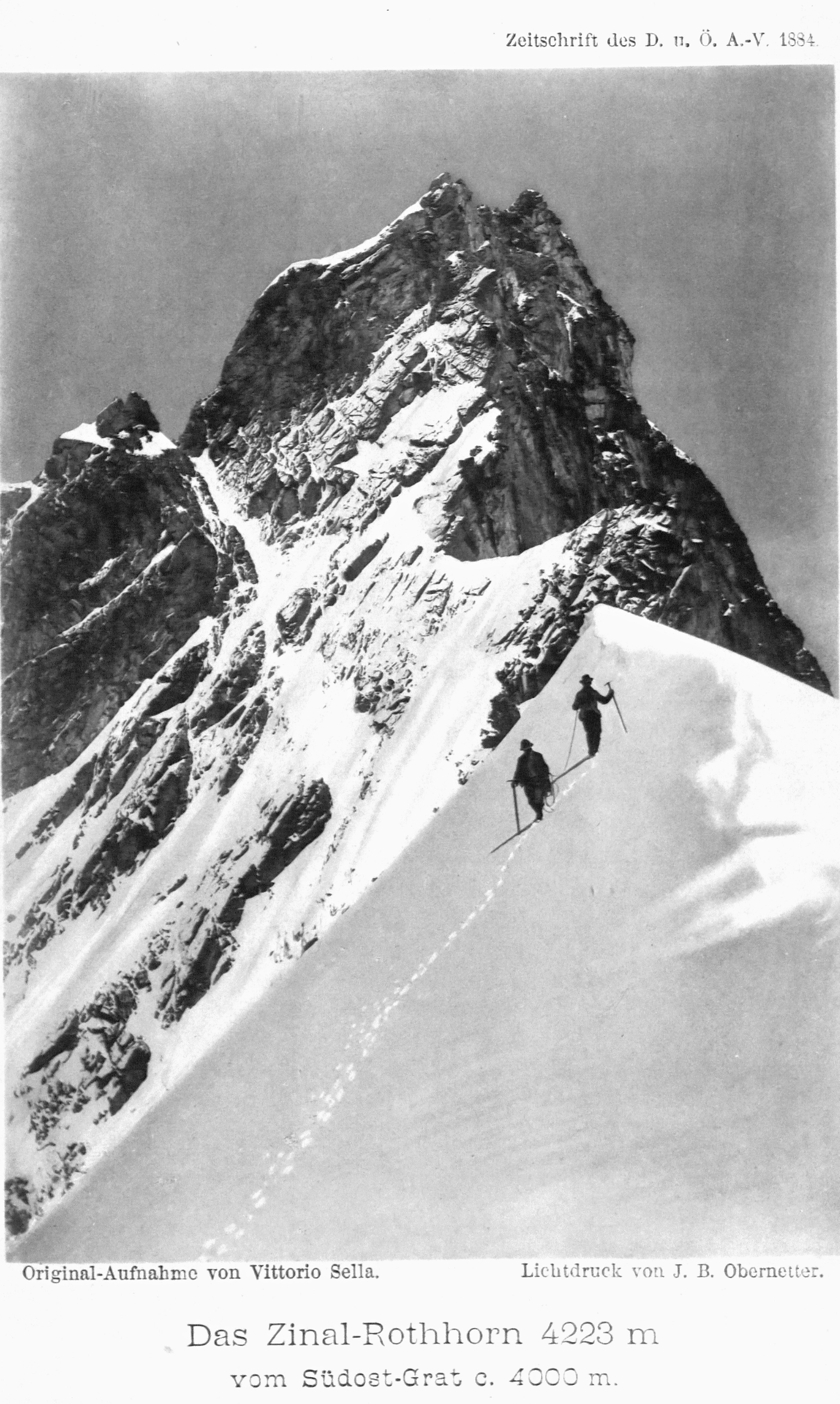
Facing page 220 of the fifteenth volume of the Zeitschrift des Deutschen und Oesterreichischen Alpenvereins, published in 1884, there is an upright plate of two men on a snow crest. Three lines of letterpress sit under the picture and they are unusually generous. One names the photographer — Original-Aufnahme von Vittorio Sella — one names the printer, J. B. Obernetter of Munich, and the third names the subject and the camera's own position: Das Zinal-Rothhorn 4223 m vom Südost-Grat c. 4000 m. The picture states where it was made from: the south-east ridge, at about four thousand metres, looking up at the men climbing it.
Nearly everything the Exposure column argues about a slope of snow was already true in that frame. A reflected-light meter renders what it sees as a mid-tone, and snow is not a mid-tone; sunlit snow and shaded snow are lit by two different sources; a frame that is mostly snow will be metered wrongly by a machine that is behaving correctly. Sella had none of those machines. He had glass, one exposure per sheet, an emulsion that could barely see red, and — in 1884 — no numerical measure of his own plate's speed, because no such measure had yet been invented.
The ridge the plate names
The article the plate belongs to is Das Zinal-Rothhorn 4223 m bei Zermatt, by Dr Bruno Wagner of Vienna, and it is a route survey rather than a trip report. Wagner sets out three lines on the mountain, gives the Zermatt approach along the south-east ridge as opened on 5 September 1872 by C. T. Dent and Passingham, and records his own ascent on 2 August 1879, on which a fall of stones and snow below a notch called the Gabel put his party in serious difficulty. He describes the ground in the picture directly: a characteristic snow crest crowning the Rothorn glacier, narrowing continually as it rises to the final structure of the peak, and above it a broad ice slope shot through with ribs of rock.
An editors' footnote on page 220 ties the text to the plate. This, it says, is the place the collotype shows; here the ice slope is still heavily covered with snow, whereas on Wagner's own ascent bare ice frequently prevailed and the rock was largely clear. The same footnote thanks Sella in Biella for permission and calls the picture one of the finest masterworks with which, in the journal's phrase, that amateur has made a gift to the friends of the high mountains.
The sources disagree about the mountain in small, checkable ways worth keeping rather than smoothing. Wagner in 1884 dates the first ascent to 21 August 1864 and credits Florence Crauford Grove and Leslie Stephen; the modern English gazetteer entry gives 22 August 1864 and adds the guides Melchior and Jakob Anderegg, whom Wagner does not mention. The 1884 plate calls the summit 4,223 m; the current figure is 4,221 m. The spelling has lost an h: Zinal-Rothhorn then, Zinalrothorn now, from the village of Zinal and the German for red peak. Neither Wagner nor the journal names the two men on the crest, and neither says who, if anyone, was on the rope behind the camera.
A mountain named for a colour
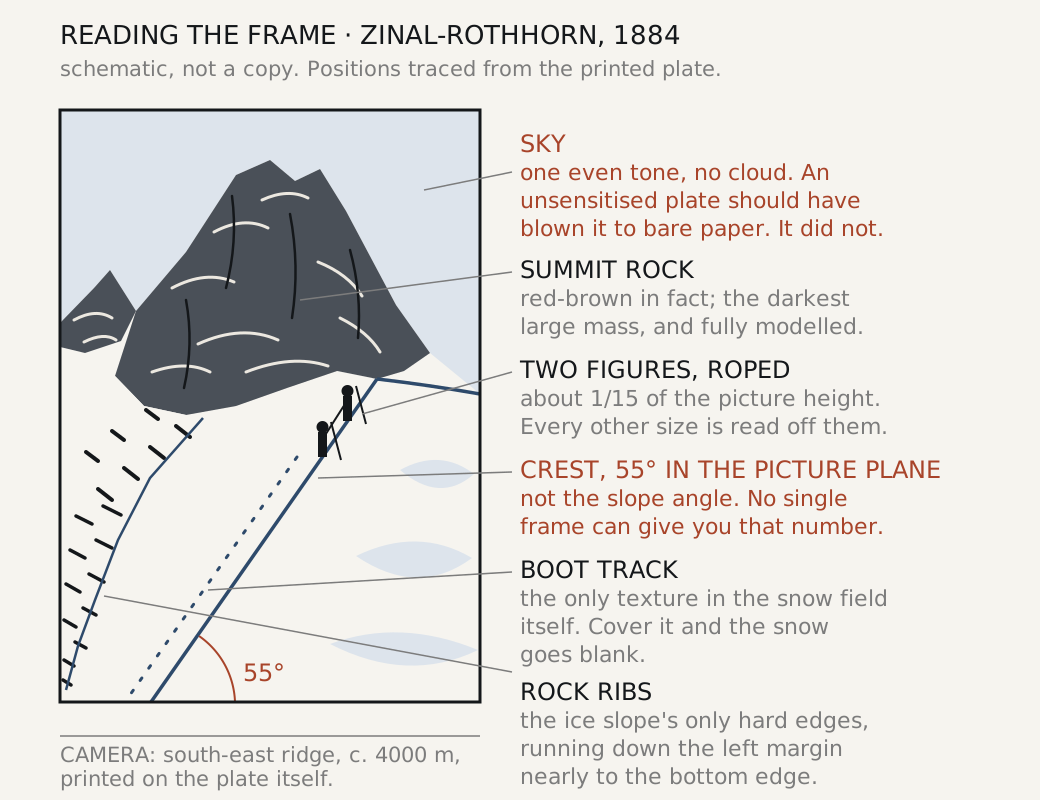
Wagner calls the peak a rothbraune Felspyramide — a red-brown rock pyramid. In the plate that red-brown mass is the darkest large area in the print, and this is not an accident of printing. It is also the most heavily modelled thing on the sheet. Measured on the Commons scan, against a blank paper margin of 250 and sunlit snow of about 205 out of 255, the rock's median sits near 100 and barely a per cent of it falls below 30; every stratum, gully, ledge and snow patch stays legible. It is a dark grey, not a hole.
A silver halide emulsion as naturally prepared is far more sensitive to blue and ultraviolet than to green or red. Hermann Wilhelm Vogel showed in 1873 that dyes could extend sensitivity into the green — erythrosine gave the orthochromatic plates that followed — and full sensitivity across the visible spectrum arrived commercially only with the panchromatic plates sold by Wratten and Wainwright in 1906, twenty-two years after this picture was published. On non-panchromatic stock the standard complaint is exactly what the plate shows: red subjects render far darker than the eye reads them, and blue ones far lighter.
That is one half of an inversion that ought to be better known. The other half is the snow. Freshly fallen snow reflects more visible light than any other natural surface, with an albedo the WSL Institute for Snow and Avalanche Research SLF in Davos puts as high as 95 per cent across the visible band it defines as roughly 400 to 680 nm. Snow out of the sun is lit chiefly by blue sky. On a plate whose sensitivity is concentrated in the blue, sky-lit shadow snow therefore records with far more energy than the eye credits it with, and the gap between sunlit and shaded snow narrows. The emulsion that pushed the rock down the scale was, on the snow, doing the opposite of what a modern reader assumes: it was filling the shadows in.
The sky is the anomaly
The sky in this plate does not behave as that argument predicts. It is an even mid tone with no cloud and almost no gradation, and it is clearly darker than the sunlit snow — darker, too, than the blank paper margin of the same scan, which rules out simple paper discolouration. On an unsensitised emulsion a clear alpine sky is the brightest thing in the scene and normally prints as bare paper.
Where that tone came from, the record reached here does not say. It could have been controlled at the negative, at the print, or on Obernetter's gelatin; or the sky may not have been clear at all but a uniform high veil, which an ordinary plate would render as the same flat field. The plate cannot distinguish the two cases and neither can this desk, and a reader is better served by the open question than by a confident reconstruction of a decision nobody wrote down.
Everything is read off the track
Strip the plate to its structure and most of the lower third is a single broad flank of sunlit snow with almost no modelling in it — a large pale field with a few soft wind hollows and, apart from the dark rock ribs that run down its left margin almost to the bottom edge, nothing else. Across it runs the party's boot track, a dotted line of steps descending to the lower-left corner, and it is the only texture in the snow field itself. Cover it and the snow goes blank. It is the same device the Exposure column reaches for under flat light: when the surface itself supplies no gradient, the frame has to borrow structure from something a human put there or from something dark enough to survive.
The two figures do the other structural job. They stand about one fifteenth of the picture height — small enough that the ridge dwarfs them, large enough that hats, coats, long-shafted axes and the rope between them are all legible — and every other dimension in the frame is measured against them. Nothing else in the picture has a known size. Sella used that device for fifty years, and it is why his Karakoram and Caucasus plates read as enormous rather than merely distant.
One number the frame refuses to give is the slope angle. The crest meets the bottom edge of the picture at about 55 degrees, but that is 55 degrees in the picture plane, a joint product of the true angle, the direction the camera was pointing and how the body was rolled. It is the same trap the Slope column sets out at 200mm: a photograph is an extremely poor instrument for measuring the steepness of the ground it is standing on.
One plate, one exposure
In 1884 there was no way to state how fast a plate was. Ferdinand Hurter and Vero Charles Driffield's Actinograph, the slide-rule device that turned latitude, season and hour into an exposure, dates from 1888, and the paper that founded sensitometry — Photo-chemical Investigations and a New Method of Determination of the Sensitiveness of Photographic Plates — was published in 1890. The density-against-log-exposure curve that every modern raw-headroom measurement descends from still carries their initials. When this picture was exposed, none of it existed. A plate's speed was a matter of the maker's reputation and the photographer's memory.
Against that, the cost of being wrong. The Fondazione Sella in Biella, which holds the archive, describes a fonds running from 1879 to the end of the 1930s and built on 30 × 40 cm plates and smaller sizes. Thirty by forty centimetres of glass, carried to four thousand metres, exposed once. No bracket, no second frame at a different setting: the decision is made before the shutter and confirmed weeks later. Every argument this publication makes for setting exposure manually before a rider drops, rather than letting a meter re-decide it mid-run, restates a constraint Sella had no way to escape.
Two generations from the negative
The volume says twice that what Obernetter worked from was not Sella's glass. The front-matter Verzeichniss der Beilagen files the plate under Zu Seite 220 and calls it nach einer Copie der Original-Aufnahme von Vittorio Sella in Biella — after a copy of the original photograph — so the letterpress under the picture, which says only Original-Aufnahme von Vittorio Sella, is qualified by the volume's own list of plates. The last line of the editors' footnote on page 220 supplies what that list leaves out: the collotype was made not from a glass negative but directly from an ordinary photographic paper copy of the kind sold commercially, measuring 27 by 37 cm.
So the picture above is at two removes. Sella's negative was printed on paper by whatever process and to whatever contrast the trade supplied; that print was rephotographed and transferred to a reticulated gelatin matrix; ink was pulled from the matrix. Collotype approximates continuous tone through the natural grain of the gelatin, which is why it served fine art and scientific work into the twentieth century — but it is still an interpretation, and the third in the chain. Any claim about how Sella exposed for the snow, made from this sheet, is a claim about a copy of a copy. The remarkable thing is what survives the journey: at two removes the sunlit flank still holds separation, the snow on the summit ledges still separates from the rock behind it, and the track still reads step by step.
Ansel Adams, writing in the Sierra Club Bulletin in 1946, put the case for Sella in a sentence the galleries handling the work have quoted ever since: "with Sella's sensitive insight and response the magnificence of mountains is distilled into a high order of expression." That is a judgement about seeing. The technical judgement runs alongside it and is not smaller. The scene in this frame — a roughly 90 per cent reflective surface under direct sun, a shadow side lit only by sky, and a rock mass several stops down from both in the same picture — is the hardest ordinary lighting situation in photography, and it was solved once with no meter, no sensitometry, no colour correction and one sheet of glass.
The teams that worked Courmayeur for Click on the Mountain between 2009 and 2018 met that scene inside a shooting window the organisers' own programme pages for 2016 and 2017 put at three days, under Monte Bianco, with instruments Sella never had and a subject he never had to deal with: a rider in frame for a second and a half. What they did not have is any claim to a new problem. Wagner's own text is a reminder that the mountain has not softened either — he singles out the traverse below the Gabel as the place where, late in the day, the sun releases what is holding the stones, and the modern institutional version of that warning is the five-level European avalanche danger scale published by AINEVA, which lists wet snow among the standard avalanche problems. Alpine contrast is not a modern complaint, and neither is the ground.
Something here wrong or incomplete? Corrections are published, dated and kept: /corrections/.