Courmayeur · Aosta Valley · Cresta d’Arp · Chécrouit · Val Veny · Monte Bianco · Freeride · Klaus Polzer
The GroundWhy It Was Always March: Sun Angle, Snowpack, and the Narrow Window Courmayeur Gives
Eight of the ten editions carry a date, six of them fall inside sixteen days of calendar, and the reason is computable — at 45.79° N a forty-degree north-facing face gets no direct sun at solar noon until 10 March.
A contest with no set course still has one fixed decision, and it is the calendar. From its second edition in 2010, on the evidence of the contest's own archived rosters, Click on the Mountain gave four teams a photographer and riders — with an alpine guide named against every team in 2010 and again from 2014, the 2011, 2012 and 2013 roster pages naming riders only — and then let them choose the ground; the first edition, in 2009, ran five teams of a photographer and two riders each, with no alpine guide named against any of them. The archived schedules that survive set three shooting days in every year they cover but the last — Wednesday to Friday in 2015, Tuesday to Thursday in 2016 and 2017 — inside a six-day week that opened with a briefing and closed with the awards. For 2018 the archive does not settle it: the 2018 programme contradicts itself, marking Friday 9 March as free shooting as well as media day and editing day, while the same page's free-shooting block lists Tuesday to Thursday only and its awards entry still speaks of three days of shooting. Three days, or at the outside four, is the whole of it either way. What no edition let the teams choose was which week of the winter those days fell in. Eight of the ten editions carry a date that can be checked, and six of those eight — every edition from 2013 to 2018 — begin and end inside sixteen days of calendar, between 24 February and 11 March.
The dates the archive fixes
| Edition | Dates on the record | Where the dates come from |
|---|---|---|
| 2009 | not established | no source located |
| 2010 | not established | no source located |
| 2011 | 22–26 March | neveitalia.it, which calls it the third edition |
| 2012 | 27–31 March | the organisers' release of 22 March 2012, archived |
| 2013 | 25 February – 2 March | the organisers' release of 6 February 2013, archived |
| 2014 | the last week of February, closing Saturday 1 March | boardsportsPR gives 24 February as the start; bergstolz.de gives 25 February |
| 2015 | 3–7 March | the archived schedule page; skiing.de, 2 March 2015; montagna.tv, 21 February 2015 |
| 2016 | 29 February – 5 March | the archived schedule and news pages |
| 2017 | 6–11 March | the archived schedule page; up-climbing.com, which reports the close on Saturday 11 March |
| 2018 | 5–10 March | the archived schedule and news pages |
Archived contest pages are used as fact evidence only. The 2014 start date is left in the safe form the two sources support, because boardsportsPR and bergstolz.de disagree by one day and both agree on the Saturday close. A banner on the contest's own Italian main page advertised 2015 as 3–8 March, one day longer than the schedule page on the same site; the schedule page is preferred here and the discrepancy is recorded rather than resolved.
Two things fall out of that table before any physics is applied. The first is that the late-March slot the contest used in 2011 and 2012 was abandoned and never returned to. The organisers' release of 22 March 2012, archived, put the fourth edition's start on 27 March and its closing party on Saturday 31 March — the latest date anywhere in the ten-year record, and the same release widened the declared shooting ground to take in the Vallée Blanche, the Val Ferret and the Chécrouit–Val Veny sector. Eleven months later the release of 6 February 2013, also archived, announced the fifth edition for 25 February to 2 March: a month earlier in the calendar, on the same ground, with three shooting days. The shift happened once, between two consecutive editions, and it held — no edition after 2012 begins later than 6 March. The second thing that falls out is that no archived page or press report located in this session states why. The pattern is real; the intention behind it is not on the record, and the argument below is an account of what the ground and the sun do in that slot, not a claim about what the organisers were thinking.
Computation, not observation
Courmayeur sits at roughly 45.79° N, 6.97° E. Solar position there is arithmetic, and the arithmetic is unforgiving in December. At solar noon on 21 December the sun stands 20.8° above a flat horizon. On 21 January it has recovered only to 24.3° — no better than 21 November. Then it climbs quickly: 33.6° on 21 February, 38.4° on 5 March, 44.7° on 21 March, 56.3° on 21 April.
Day length moves with it but more slowly, and less usefully. Sunrise to sunset runs 8 h 40 m at the solstice and 10 h 53 m on 25 February — a gain of just over two hours across nine weeks. The hours that matter to a photographer are not the ones near the horizon, and those move far faster. The sun stands above 30° for no part of the day in January, for 3 h 33 m on 25 February, and for 5 h 03 m on 10 March.
The longitude catches people out. Courmayeur keeps Central European Time, referenced to 15° E, and sits eight degrees west of it, so solar noon falls near 12:45 on the clock in early March, not at 12:00. The middle of the light is three-quarters of an hour later than the watch suggests.
A forty-degree face waits
Elevation alone does not decide whether a slope is lit. Aspect does, and at Courmayeur the aspect is the whole argument. Ultimate-Ski's published resort description sets the two flanks of the lift-served area out as opposites — Chécrouit "is North East facing and gets the morning rays", while Pré de Pascal and Val Veny are "North West facing and warms up in the afternoon". Both, on that description, look into the northern half of the compass, but neither looks due north, and the quarter-turn matters: a plane angled that far off the shadow line is lit weeks earlier in the season. The computation below takes due north first, because it is the limiting case, and gives the numbers for the two sectors Ultimate-Ski describes after it. The terrain the teams were repeatedly documented on is named in the record but not oriented in it: skiing.de's mid-event report from the 2015 edition describes teams hunting untracked powder at Cresta d'Arp during a week in which the weather gave them very little, and no source located in this session states which way that ground faces.
For a planar slope facing due north, with the sun due south at solar noon, the geometry collapses to one line. The cosine of the angle of incidence reduces to sin(θ − α), where θ is the solar elevation and α the slope angle. The slope receives direct sun only when θ exceeds α; below that threshold the whole plane is in its own shadow.
That single relation puts dates on the calendar. A 24° north-facing plane below Cresta d'Arp is out of direct sun at solar noon from about 23 November until about 20 January. A 30° pitch waits until 11 February. A 40° face — the pitch a freeride photographer is usually there for — receives no direct sun at solar noon until 10 March. That is when the steep north-facing ground stops being a shadow with texture in it and starts being a lit subject.
Due north is the extreme case, though, and Chécrouit and Val Veny are not it. Turn the plane away from the shadow line and the wait shortens quickly: for a slope of angle α whose aspect is δ degrees off due north, the noon threshold θ is given by tan θ = tan α · cos δ, so the quarter-turn that separates north-east and north-west from due north cuts the tangent by about 29 per cent. A 40° pitch facing north-east or north-west — which is what Ultimate-Ski describes the two lift-served flanks as — needs only 30.7° of solar elevation, and gets it at noon from about 13 February, nearly four weeks before its due-north neighbour. A 30° pitch on those aspects needs 22.2°, and is out of the noon sun only for about five weeks either side of the solstice, from roughly 3 December to roughly 10 January. A 24° pitch on them needs 17.5°, which is below the 20.8° the noon sun never drops beneath here: on the arithmetic, that slope is never out of direct sun at noon at all.
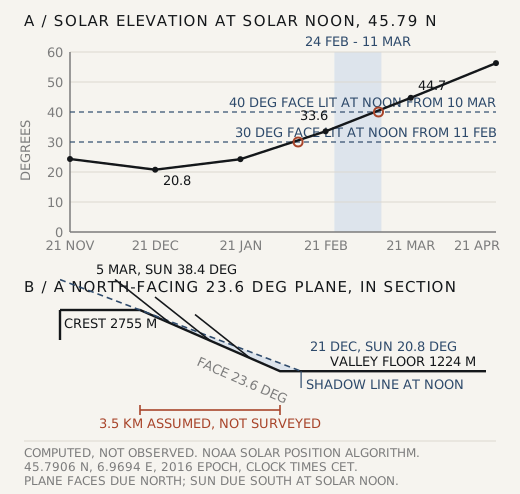
The same relation governs the valley floor, which is why the town reads so differently in January and March. Courmayeur sits at 1,224 m and Cresta d'Arp at 2,755 m, on the Regione Autonoma Valle d'Aosta's own figures — a rise of 1,531 m. Assume, and this is an assumption rather than a survey, a horizontal separation of about 3.5 km. The skyline then stands 23.6° above the valley floor, and a sun at 20.8° on 21 December never clears it: the whole face is shaded, and the shadow spills roughly half a kilometre out onto the floor beyond its base. By 5 March the sun at 38.4° is well above both the crest angle and the face angle, and neither the slope nor the floor is in shadow at noon. The contest's own 2016 pages are quietly consistent with the difficulty of the floor: the archived Le origini del Click OTM page made the Thursday public street session in the village conditional — neve permettendo, snow permitting, or "if snow conditions are good" in the English version of the same page — while the archived programme page listed it without any condition. A town at 1,224 m in the first week of March is not a reliable snow surface.
Lit ground is warming ground
Sun angle only sets one side of the trade. The other side is that a slope which is being lit is also being warmed, and the institutions that track that in the Aosta Valley are explicit about the mechanism. The regional snow and avalanche bulletin is coordinated by Fondazione Montagna Sicura, based at Villard de la Palud in Courmayeur itself, on behalf of the Regione Autonoma Valle d'Aosta, using a network of privately employed snow observers accredited by AINEVA alongside forest rangers, alpine guides, mountain-rescue personnel and lift-company staff.
The wet-snow problem those bulletins describe is a diurnal one. The European Avalanche Warning Services, whose standards the Regione Autonoma Valle d'Aosta's bulletin site links to alongside AINEVA's, define it as a weakening of the snowpack caused by liquid water infiltrating it, through melt or rain; where melt is the cause, the problem is confined to particular aspects, because it is solar radiation that supplies the energy, and to particular elevations, because air temperature sets the limit. Natural avalanches, the European Avalanche Warning Services standard says, become more likely in the course of the day. After a clear, cold night that builds a strong crust, the same standard notes, the morning can be favourable — and after a warm, overcast night the problem is already there at dawn.
That is the trade in one sentence: the sun angle that finally reaches a 40° due-north face in the second week of March is the same sun angle that, on the European Avalanche Warning Services' account of the wet-snow problem, has for weeks been supplying the energy for it on the aspects it was already reaching. Where that trade lands on any given day is not a question a photography reference can answer, and this one does not try. It is the question the Aosta Valley bulletin, published for the Regione Autonoma Valle d'Aosta with Fondazione Montagna Sicura's technical support, exists to answer, and it is answered daily and locally rather than seasonally and in general.
The season around the window is short at both ends. The Regione's own tourist database listed the Courmayeur Mont Blanc ski area as open from 29 November 2025 to 6 April 2026 when it was checked on 6 August 2026 — dates that change every season and should be read as an order of magnitude, not a fixture. A contest held in the second week of March is being held about four weeks before the lifts stop.
The window is not fixed
Weather inside the window did what weather does. During the 2015 edition, skiing.de reported a cloud-covered Wednesday, then a Thursday on which strong wind closed the upper part of the area and pushed every team below the treeline, then a Friday for which the same report said perfect conditions were forecast and each team still had thirty minutes of flight time with Courmayeur Heliski to use. Klaus Polzer, one of the four photographers in the field that year, told skiing.de mid-week that this sort of thing simply happens and is in the nature of outdoor sport, and that his team would find something anyway. A window a few weeks wide does not guarantee a single usable day inside it.
Nor is the window itself stable across decades. Matiu and colleagues, publishing in The Cryosphere in 2021 on more than 2,000 Alpine stations measured between 1971 and 2019, of which the paper says more than 800 were used for the trend assessment, reported March mean snow-depth trends at 1,000–2,000 m of −3.9 cm per decade in their northern high-Alpine grouping and −7.0 cm per decade in the southern one, with the strongest and most significant negative trends concentrated in the spring months. The Regione Autonoma Valle d'Aosta publishes daily snow-depth series for a station network that includes Pré-Saint-Didier, a few kilometres down-valley from Courmayeur, and the Ufficio neve e valanghe of its Centro funzionale has produced an annual Rendiconto nivometeorologico since 2005, with Fondazione Montagna Sicura's technical support since 2009 — twenty editions of exactly the record that would be needed to say what has happened to a March week at this latitude.
What the arithmetic supports, and all it supports, is that the four weeks from about 13 February to 10 March at 45.79° N are the span across which steep ground in the northern half of the compass comes into direct sun at noon, aspect by aspect, while still carrying winter snow — and is lit for several hours either side of a solar noon that arrives at about a quarter to one. Six consecutive editions of a photography contest were held across that span. The record does not say the organisers reasoned it out. It does say they stopped moving.
Something here wrong or incomplete? Corrections are published, dated and kept: /corrections/.