Courmayeur · Aosta Valley · Cresta d'Arp · Val Veny · Chécrouit · Klaus Polzer · Freeride skiing · Ski photography
ExposureNo Shade on a South Face: Alpine Contrast, and the Two Colour Temperatures of a Single Slope
Computes where the sun actually stands above Courmayeur in early March, and shows why one white balance cannot serve snow lit by a 5200 K sun and snow lit by 9000 K sky in the same frame.
The standard answer to hard light is a room's answer. Move the subject into shade. Add a reflector or a flash and lift the shadow side. Wait for the hour when the contrast collapses on its own. On a snow slope at nine in the morning, with a rider booting up a spine and a lift that will shut when it blows, none of the three is available: the only shade is the wrong side of the mountain, the reflector is already deployed and is the size of the valley, and the softening hour darkens the working terrain.
What is left is a problem the portrait literature never has to solve — two illuminants, geometrically separated, in one frame, with no way to switch either off. Snow in the sun is lit by the sun; snow out of it is lit by the sky and by whatever the sun has bounced off other snow. The two differ by roughly three stops in brightness and something on the order of seventy mireds in colour, and the white balance that is right for one is visibly wrong for the other.
Where the shade went
At 45.79° N the sun reaches 35.2° above the horizon at local noon on 25 February, 38.2° on 5 March, 40.2° on 10 March and 44.5° on 21 March. Day length on 5 March is 11 hours 20 minutes, and solar noon falls at about 12:44 CET, because Courmayeur sits west of the meridian that defines its clock.
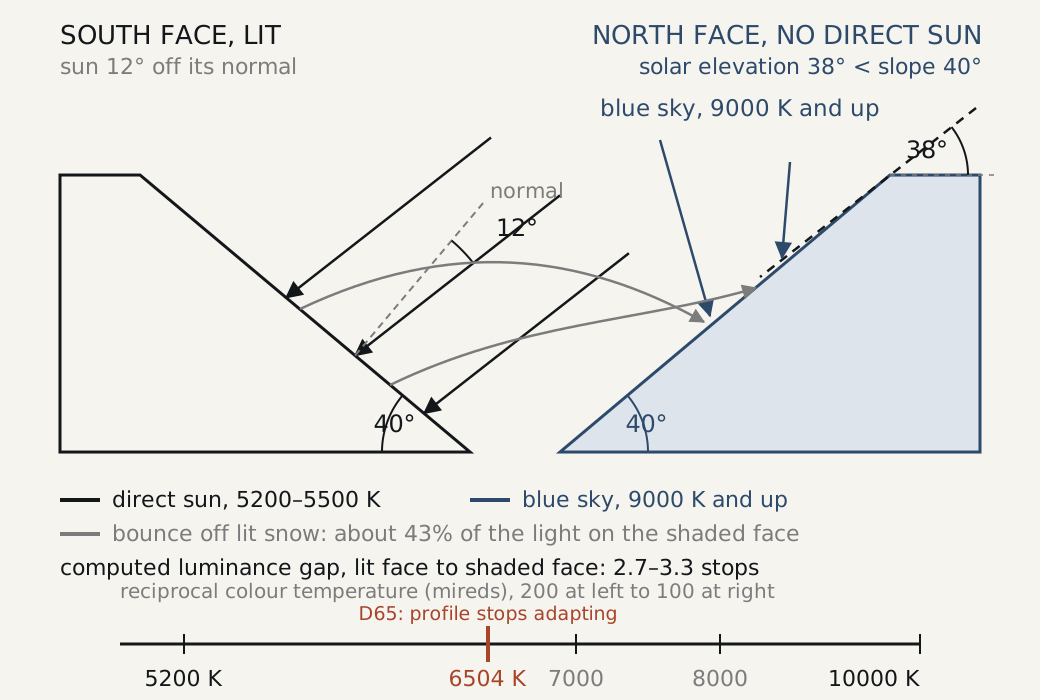
Set a 40° slope facing due south against those numbers and the beam arrives about 12° off the surface normal at solar noon — near enough to perpendicular that the face is at maximum illumination — and stays within about 28° of it from 11:00 to 14:00. Nothing on such a face casts shade except the terrain's own convexities, the rider, and the photographer.
Set a 40° slope facing due north against the same numbers and something harsher happens. On 5 March the angle between the beam and that surface never falls below 91.8°: the sun stays below the plane of the face, which gets no direct sunlight at any hour. The threshold is simple — at local noon a slope of angle β facing due north sees the sun only when solar elevation exceeds β — and here a 40° north face crosses it around 10 March. By late June the sun rises well north of east, and the same face is lit from sunrise to sunset, roughly 04:50 to 20:20 CET.
So there is no shade on a south face, and the shade across the valley is not somewhere to move a subject to: it is a different exposure, a different colour, and usually a different slope.
Courmayeur's lift-served terrain supplies both aspects at once. The Regione Autonoma Valle d'Aosta's tourism department publishes the ski area as two sides — Val Veny and Plan Chécrouit — rising from the town at 1,224 m to Cresta d'Arp at 2,755 m. A photographer in that cross-section has a lit flank and an unlit flank in one field of view all March morning.
Snow reports its illuminant
Most surfaces impose a colour of their own on the light that falls on them; snow does not, which is why the two-illuminant problem shows up here rather than on grass. Stephen G. Warren of the University of Washington, reviewing the optical properties of ice and snow in Philosophical Transactions of the Royal Society A in 2019, gives the figure plainly: the albedo of Antarctic surface snow "decreases only slightly from 0.99 at 400 nm to 0.96 at 700 nm". His explanation is that ice is a weak absorber of red over short path lengths — a photon undergoing a thousand refractions among grains of about 100 µm radius still traverses only about 20 cm of ice — so snow is white rather than blue. A near-neutral reflector at 96–99% reports the colour of whatever lights it, almost unaltered, so a frame of snow is very nearly an unfiltered record of the illuminant, and where two illuminants divide the frame the division is recorded at full strength.
That 96–99% is Antarctic snow and the visible band only. Warren notes that coarse grains absorb more than fine ones and that slight melting coarsens them, so near-infrared albedo falls where the visible band barely moves, and a broadband figure for the same snow is lower and moves with the state of the surface. The irradiance model below accordingly assumes 0.85 for the valley's snow and 0.95 for the sunlit surface — modelled inputs, not rival measurements.
Two sources, one frame
The reference frame is standardised. ISO/CIE 11664-2:2022, Colorimetry — Part 2: CIE Standard Illuminants, from the Commission Internationale de l'Éclairage, defines illuminant A at approximately 2,856 K, D65 at approximately 6,500 K and D50 at approximately 5,000 K, each as a spectral power distribution tabulated from 300 nm to 830 nm at 1 nm intervals. Camera makers set their daylight presets near D50: the Nikon Z 8 reference guide gives Direct sunlight as approximately 5,200 K, and so does the Canon EOS R5 Mark II manual for Daylight.
The sky is a different object, and it has been measured. Javier Hernández-Andrés, Javier Romero and Raymond L. Lee, in the Journal of the Optical Society of America A in 2001, analysed over 1,500 clear-skylight spectra at Granada in Spain and reported, across 44 view directions, "correlated color temperatures (CCT's) ranging from 3800 K to ∞ K" and chromaticities that "are close to but do not coincide with the CIE daylight locus". A companion study of 2,600 daylight spectra at the same site found chromaticities "far above the CIE locus at high CCTs (>9000 K)".
Two things follow that no camera preset admits. Skylight has no single colour temperature; it depends on which part of the sky the shaded snow can see. And it sits off the daylight locus, so a Kelvin dial, which walks that locus, cannot land on it exactly whatever number is chosen — the residual comes out on the green-magenta axis.
The reflector nobody switches off
The shaded face is not lit by sky alone, and that is the part the forums miss. Model a clear early-March day at 900 W/m² direct-normal irradiance and 100 W/m² diffuse horizontal — a diffuse fraction of about 0.15 — and put a 40° north face in a basin of snow at 0.85 albedo. On the standard isotropic-sky assumption, roughly 57% of what reaches that face is sky and roughly 43% is sunlight bounced off the lit snow across the valley.
Mixing those on the CIE daylight locus gives an effective illuminant of about 7,000 K when the sky itself is at 9,000 K, about 8,000 K at 12,000 K, and about 9,500 K at 20,000 K. Alpine shade on snow is therefore usually warmer than the sky above it, and it moves when the geometry moves: a north couloir walled in under a cliff sees less lit snow, loses the bounce term, and runs toward the sky's own value. That is why a photographer nails the white balance one day and misses it the next — the illuminant is a mixture whose proportions terrain sets.
The same reflector shows up in the health record for this region. Siani, Casale, Diémoz, Agnesod and colleagues, writing in Atmospheric Chemistry and Physics in 2008, measured personal ultraviolet doses on the ski field at La Thuile–Les Suches in the Aosta Valley and reported a winter median exposure ratio — personal dose against ambient dose on a horizontal surface — of 0.60, against 0.09 to 0.42 for sunbathers on a beach in central Italy. Mountain sites, they write, see enhanced ultraviolet "due to the concurrent effects of shorter radiation path-length, low aerosol load and high reflectivity of the snow surfaces", a finding underwritten by the spectroradiometry ARPA Valle d'Aosta has run at Aosta–Saint-Christophe since 2006.
What a correction costs
Colour temperature is not a linear scale, and the correction arithmetic only makes sense in mireds — reciprocal megakelvin. 5,200 K is 192 mired; 7,000 K is 143; 8,000 K is 125; 10,000 K is 100.
Manufacturers do not agree on where alpine shade sits. The Nikon Z 8 reference guide sets Shade at approximately 8,000 K; the Canon EOS R5 Mark II manual sets it at 7,000 K — an 18-mired disagreement about the same condition, before any slope is involved. Both cameras cap the manual Kelvin selector at 10,000 K, below much of the range Hernández-Andrés and Lee measured in clear sky.
A camera set for sunlit snow at 5,200 K renders shaded snow at 8,000 K some 67 mired cold; set for the shade, it renders the lit snow 67 mired warm. Split at about 6,300 K and both regions are 34 mired out in opposite directions — the worst available outcome in a picture whose subject is white.
The raw file does not dissolve the problem, and the specification says so. Adobe's Digital Negative Specification 1.6.0.0, dated December 2021, defines CalibrationIlluminant1 and CalibrationIlluminant2, recommends pairing a low-colour-temperature illuminant such as Standard-A with a higher one such as D65, and mandates "linear interpolation using inverse correlated color temperature" — with a clause that matters more than it looks: "If the white balance temperature is between two calibration illuminant temperatures, then invert all the temperatures and use linear interpolation. Otherwise, use the closest calibration tag set."
The second sentence is the operative one. D65 is 6,504 K, or 154 mired, so every white balance a photographer might pick for alpine shade — 7,000 K, 8,000 K, the 10,000 K stop at the end of the dial — sits outside the calibrated pair, and the converter stops interpolating and applies the D65 colour matrix unchanged. Only the channel multipliers move; the profile is being asked to extrapolate and is declining. The DCamProf documentation at torger.se puts the consequence in the region alpine shade occupies: the choice of upper calibration illuminant changes how deep blues render at "high light temperatures (say sky light 10000-18000K)".
The sensor is not the limit
None of this is a dynamic-range failure. On the model above, sunlit snow at 0.95 reflectance against dark technical clothing on the shaded side comes to about six and a half stops of scene range. DxOMark, which defines its landscape score as "the maximum dynamic range of the camera sensor" in EV, returned 14.8 EV at base ISO for the Nikon D850 and calls 12 EV excellent. Bill Claff's photographic dynamic range at Photons to Photos, a stricter measure he calls "distinctly different from dynamic range as defined in engineering terms", still leaves headroom.
What there is no headroom in is colour. Exposure latitude recovers a shadow; it does not reconcile two illuminants. The choice on a slope is therefore not the frame's white balance but which of the two whites the photograph is about, and whether the other is allowed to sit blue — which, on a mountain, it very often should, since an observer's own eye fails to correct that blue as well.
The window Courmayeur gave
The contest that ran on this domain spent most of its life inside the awkward part of that geometry, but not all of it. Six of its eight dated editions fell between late February and mid-March — 25 February to 2 March in 2013, 3 to 7 March in 2015, 5 to 10 March in 2018 — where solar noon elevation runs from about 35° to just under 41°. A 40° north-facing slope stayed out of the direct beam for the whole of the 2013, 2014, 2015 and 2016 weeks and began catching noon sun only on the last day or two of 2017 and 2018, so lit and shaded terrain were separated by aspect, not by hour.
The other two dated editions break the pattern. The third ran 22 to 26 March 2011 and the fourth 27 to 31 March 2012, when noon elevation runs from about 45° to about 49° — past the threshold, so the same north face took direct sun from sunrise to sunset, though at a grazing angle: the beam came no closer than 83° to the normal in 2011 or 81° in 2012, leaving that face under a sixth of what the south face took at the same instant. The brightness split survives; its purity does not. In those two weeks the shaded side carried a weak direct component mixed into its sky and bounce, so the clean two-illuminant case describes late February and early March, not the whole run.
The organisers made light a judged category in its own right. From the 2016 edition the published theme list carried four — action, lifestyle, street and light effect — and the 2018 winners page records Best Light Effect going to Team 3, the photographer Klaus Polzer with the skiers Sophie Lechasseur and Giulia Monego.
The alternative condition removes the problem and substitutes a worse one. skiing.de reported on 8 March 2015 that the Wednesday of that edition was overcast and that the Thursday, though sunny, brought storm winds that closed the upper area and pushed all four teams below the treeline. Under cloud there is one illuminant and no shadow line to argue about, because nothing is left to describe the shape of the slope. For the state of the snow beneath either sky the sources are regional: the Regione Autonoma Valle d'Aosta's snow and avalanche bulletin, and the Rendiconto nivometeorologico published in twenty editions since 2005–06 by Fondazione Montagna Sicura in Courmayeur.
Something here wrong or incomplete? Corrections are published, dated and kept: /corrections/.