Courmayeur · Aosta Valley · Monte Bianco · Val Veny · Società delle Guide Alpine di Courmayeur · Fabrizia Derriard · Alberto Boschiazzo · Freeride
The SlopeClick on the Mountain ran its tenth and final edition in 2018. It is not running and it is not accepting entries.
Standing in the Fall Line: Where a Photographer Can Legally and Safely Work on a Snow Slope
Click on the Mountain ran its tenth and final edition in March 2018, is not running, and cannot be taken part in — and this page sets out instead what the FIS Code of Conduct, Italy's D.Lgs. 40/2021 and the Swiss avalanche record oblige of a person who has stopped on a snow slope, is facing uphill, and cannot be seen over a convex roll.
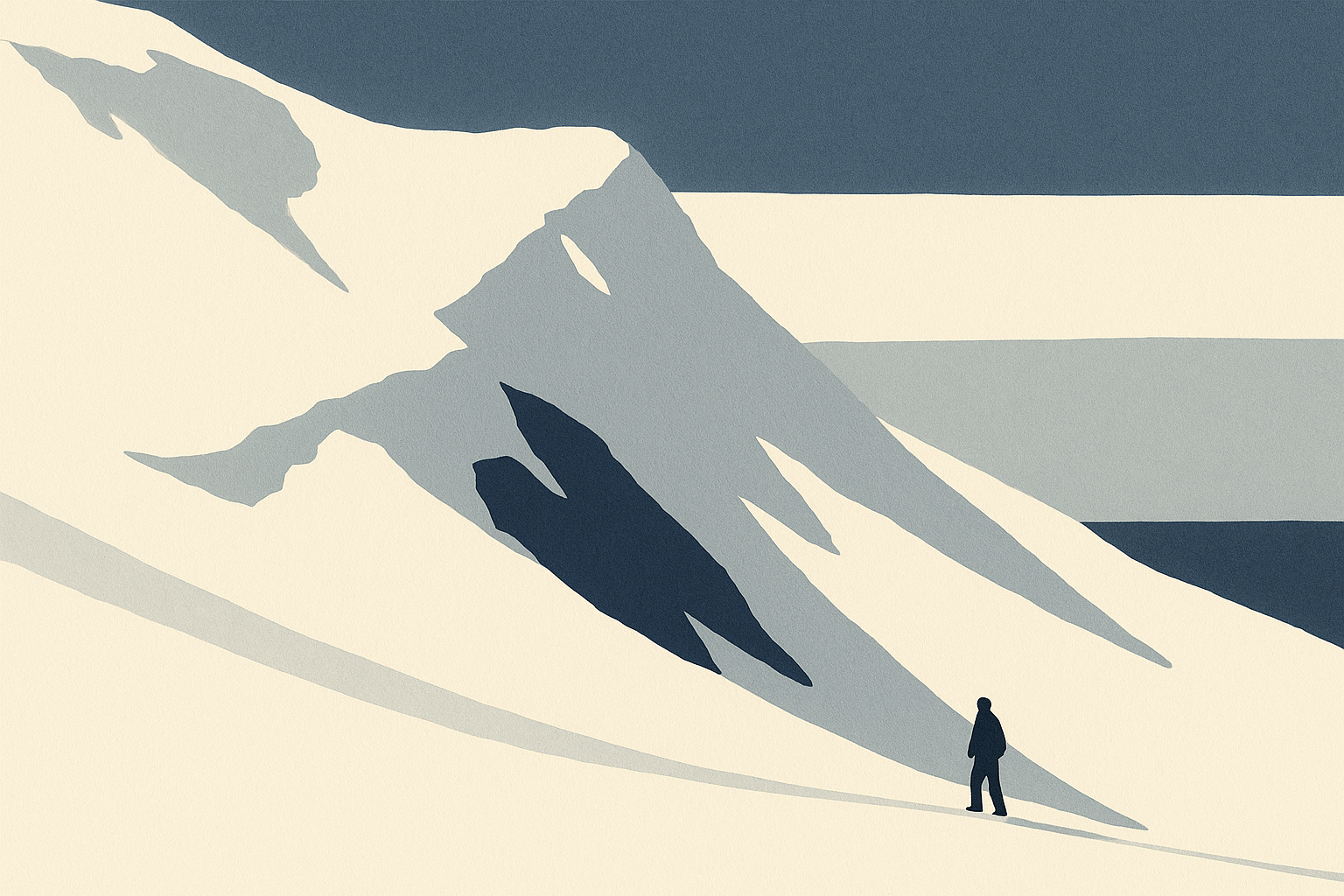
Every code of conduct on a snow slope describes a person who is moving. The photographer is the exception nobody has written down: stationary, usually below the subject, facing uphill, one eye occupied by a viewfinder, and — over a convex break — invisible to the rider who is about to arrive. The rules that govern the ground are not silent about this person. They simply address someone else.
A code written for people moving
The International Ski and Snowboard Federation publishes ten Rules of Conduct for Skiers and Snowboarders. Five of them govern a body in motion — speed, route, overtaking, moving onto a run, travelling on foot. Three are general duties that attach to everyone on the mountain: respect for others, respect for signs, and the duty to assist at an accident. One deals with the exchange of names after a collision. Exactly one addresses the person who has stopped, and it treats standing still as a condition to be ended rather than a position to be worked from. FIS rule 6, headed Stopping on the piste, reads in full: "Unless absolutely necessary, a skier or snowboarder must avoid stopping on the piste, in narrow places or where visibility is restricted. After a fall in such a place, a skier or snowboarder must move clear of the piste as soon as possible." FIS rule 7 adds that anyone climbing or descending on foot "must keep to the side of the piste".
Read as a working instruction, rule 6 says something uncomfortable to anyone carrying a camera. The three conditions it flags — necessity, narrowness, restricted visibility — are close to a description of the good picture. A photographer stops because a particular metre of ground is where the frame is; the frame is often tight because the terrain is tight; and the reason the light and the line are interesting is frequently that the ground rolls away. FIS rule 5, which covers a skier moving onto a marked run or setting off again after a halt, requires a look up and down the slope before moving. It does not say what the person who has already stopped owes the people above.
The law that replaced the law
For the whole life of the Courmayeur contest, the governing Italian statute was Law 363 of 24 December 2003, on safety in the non-competitive practice of downhill and cross-country winter sports. That is no longer the operative text, and the substitution matters to anyone reading older guidance. Legislative Decree 40 of 28 February 2021 repealed Law 363/2003 at article 43, keeping alive only article 5 paragraphs 1 and 2, article 7 paragraphs 5 and 6, and article 23; article 43-bis of the same decree states that its provisions are effective from 1 January 2022. Every edition of Click on the Mountain, 2009 through 2018, ran under Law 363/2003. Anyone standing on the same ground today stands under D.Lgs. 40/2021.
The decree's chapter on user conduct is more explicit than the FIS code and is enforceable. Article 18 makes the skier responsible for their own conduct on the piste and requires speed to be particularly moderate where the view is not clear, near buildings or obstacles, at junctions and forks, in fog, in poor visibility, in crowds and in narrow sections. Article 19 puts the obligation to avoid a collision on the uphill skier. Article 28 sets a rebuttable presumption that in a collision between skiers each contributed equally to the damage. Article 30 makes third-party liability insurance a condition of using an alpine piste at all, with a fine of €100 to €150 and withdrawal of the lift pass for going without it — a change from the 2003 regime that most English-language slope-safety writing has not caught up with. Article 29 names the bodies that enforce all of it: the Polizia di Stato, the Carabinieri, the Guardia di Finanza and the local police forces.
Stazionamento is the operative word
The article that speaks directly to a stationary photographer is article 22, headed Stazionamento. It requires skiers who have stopped to avoid creating danger for other users and to move to the edges of the piste; it forbids stopping at obligatory passages, close to rolls in the ground, and in places without visibility; it requires the piste to be cleared promptly after a fall or an accident; and it obliges anyone present to mark the position of an injured person by suitable means. Article 33 puts the fine for breaching articles 18 to 22 at €50 to €150.
The phrase to sit with is in prossimità dei dossi — in the vicinity of the rolls. The Italian decree and the FIS code arrive independently at the same prohibition, and both are naming the exact feature a photographer looks for. A convex break is where a rider becomes airborne, where the light separates from the shadow, and where the compression of the landing happens; it is also the single feature that removes the photographer from the rider's field of view.
Article 24 is the other one that bears on the job. It forbids travelling along ski pistes on foot or with snowshoes except in cases of urgent necessity; requires anyone descending without skis to keep to the edges; forbids non-participants to overtake the marked limits of a race or training session, to stop on that piste, or to travel down it; and makes uphill travel on skis, snowshoes or any other means normally prohibited, permitted only with the authorisation of the operator of the equipped ski area, or in urgent necessity, and then only as close as possible to the poles marking the piste edge. The fine is €100 to €150.
The roll that hides the rider
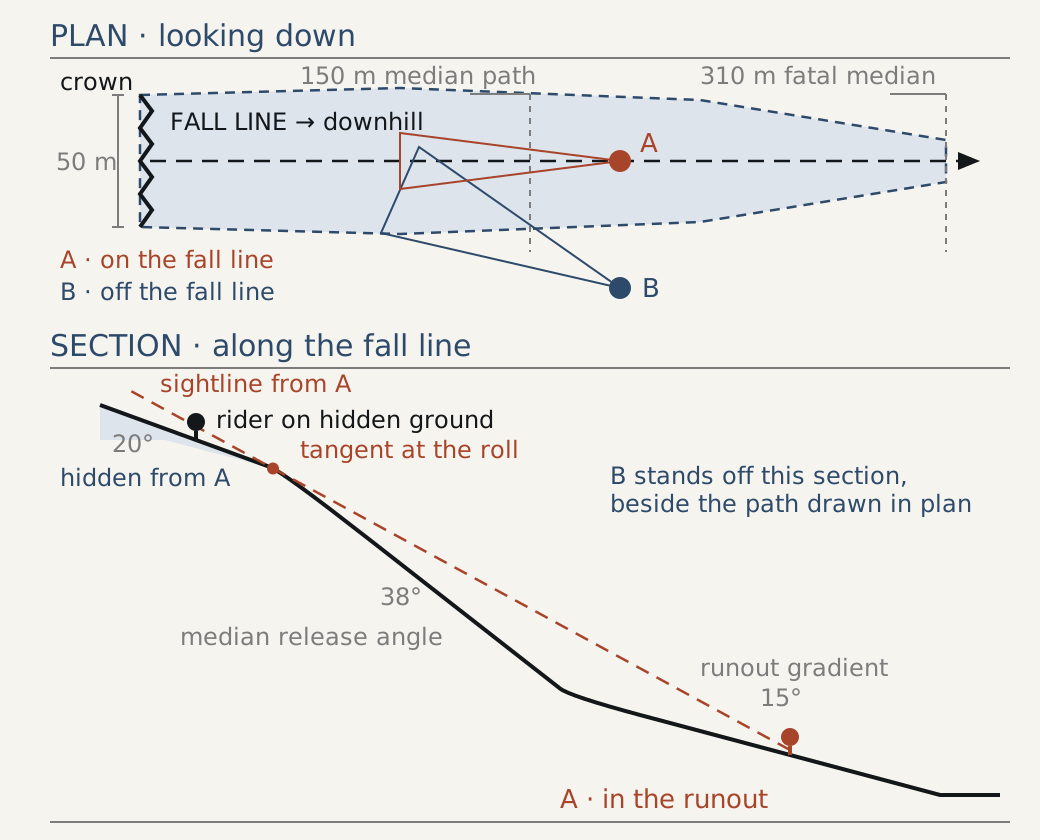
The sightline problem is geometry, and it is symmetrical: whatever hides the rider from the photographer hides the photographer from the rider. On a slope with a convex break, the tangent from a low eye position grazes the crest of the roll and everything above that tangent point is out of view. Move the eye further down the slope and the tangent point moves up only slowly, so retreating further into the runout buys very little sight of the upper face while adding a great deal of distance to the frame.
That is the case the diagram is drawn for, and it is drawn to the numbers that follow.
Below the subject, and the two horizons
A camera set below the subject and on the fall line is right about part of the picture, and the reason is geometric rather than customary. Low and on the fall line, a rider's line arrives at the lens rather than passing across it, a body in the air separates cleanly from the sky instead of merging with the snow behind it, and the slope's own horizon sits parallel to the true horizon in the frame, one slope angle above it. It is also, on the same slope, the worst available place to be standing, because "below and near the fall line" is a description of the avalanche path and of the run-in to it.
Moving round the slope, off the fall line, does not resolve that, and it does not cost the picture its pitch either. It changes which line in the frame is carrying the pitch. Cold Light's companion piece on focal length sets out the arithmetic: the slope's horizon and the true horizon are separated by the slope angle wherever the camera stands, but on the fall line that separation appears as a vertical gap between two near-parallel lines, and only a frame whose vertical angle of view is at least as large as the slope is steep can hold both — 33 mm or wider on the 36 × 24 mm format in landscape for a forty-degree face. Round to the side, and the same two lines converge and cross in the frame at the full slope angle, which is the steepest a rectilinear photograph can honestly draw a face; the price is that the reading depends on the true horizon being in the frame to be measured against, and a rolled camera adds to or subtracts from the drawn angle degree for degree. Neither position is the flat one and neither is the steep one. It is the same angle, presented twice.
What the optics cannot supply is the other variable. Whether any particular piece of ground away from the fall line lies outside a path is a judgement about the terrain and the snowpack of a given morning, and the instruments for it are institutional: the avalanche bulletin that article 26 of D.Lgs. 40/2021 obliges piste operators to post daily and give maximum visibility — for the Aosta Valley, the one issued by the Centro Funzionale of the Regione Autonoma Valle d'Aosta — and the guide who reads the day. The photographer's problem on a snow slope is that the two variables, where the picture is and where the body is allowed to be, are set by the same terrain, and only one of them can be settled with arithmetic.
Seconds for the rider, minutes for the camera
The asymmetry that no piste rule addresses is exposure time. A rider crosses an avalanche path once, at speed, in a few seconds. A photographer chooses a position, sets an exposure, waits for radio contact, waits for the light, and shoots several runs from it. The rider's exposure is measured in seconds; the photographer's, in the tens of minutes.
The scale of what they are exposed to is documented. Jürg Schweizer and Martina Lütschg of the Swiss Federal Institute for Snow and Avalanche Research SLF analysed ten years of Swiss avalanche occurrence data in Cold Regions Science and Technology in 2001 and reported that the slab detached in a human-triggered avalanche has a median width of 50 metres and a median length of 80 metres, that the median overall path length is 150 metres, that the median fracture depth is 45 centimetres, and that the median inclination of the starting zone is 38 degrees. For the accidents that killed someone, they give a median overall length of 310 metres. Their dataset also records that avalanches triggered by recreationists account for around 90 per cent of Swiss avalanche fatalities, and that 93 per cent of the accidents happened in free terrain, which they gloss in the same sentence as during recreational activities — the complement in their table being avalanches that struck transport routes or buildings, not pistes.
Those figures place the arithmetic of position beyond argument. A photographer who has walked 150 metres down from the crown to get the whole face in the frame is standing inside the median path length. At 310 metres they are at the median for the fatal cases. The EAWS glossary defines the runout zone as the lower part of the path where debris slows and stops, typically at 15 degrees or less, and notes that it can be reached from well above — which is to say that the flat, obviously safe-looking apron at the bottom of a face is the deposit.
There is a further point on which AINEVA, the Italian interregional association for snow and avalanches, is unusually direct. Its glossary of bulletin terms classifies a snowboarder making gentle turns, a skier or snowboarder who does not fall, and a group keeping at least ten metres apart as sovraccarico debole — weak additional load. It classifies two or more skiers or snowboarders who do not keep that spacing, a snow groomer, an explosion, and a person on foot as sovraccarico forte — strong additional load. A photographer who has taken the skis off and is standing in the snowpack is, by AINEVA's own classification, in the heavier of the two categories, and is in it for the whole shoot.
Article 26 of D.Lgs. 40/2021 requires anyone practising ski mountaineering, off-piste skiing or snowshoe excursions in snowy terrain where snow and weather conditions create avalanche risk to be equipped with an electronic search and location device, a shovel and a probe; the fine is €100 to €150. The same article obliges piste operators to post the avalanche bulletin daily and to give it maximum visibility, and states that lift concessionaires and operators are not responsible for accidents on off-piste routes served by their lifts. For the Aosta Valley the bulletin in question is issued by the Centro Funzionale of the Regione Autonoma Valle d'Aosta, with Fondazione Montagna Sicura — the non-profit established by regional law in June 2002 and based at Villa Cameron in Courmayeur — supporting its drafting and coordinating the observer network of AINEVA-qualified nivological observers, forest rangers, mountain guides, Guardia di Finanza alpine rescue and lift-company staff behind it.
The guide was the mechanism
The contest's own answer to all of this was institutional rather than editorial. The Società delle Guide Alpine di Courmayeur, founded in 1850, which its own site records as the first association of its kind founded in Italy and the second anywhere, appears on the event's archived technical-partner page, and the archived 2010 team records list a named alpine guide attached to each of the four teams — Luca Blanchet, Mario Mochet, Gianluca Marra and Francesco Civra Dano. The 2015 previews page presented Alberto Boschiazzo as a returning guide who worked in Courmayeur year-round. Reporting the 2017 edition in March of that year, up-climbing.com wrote that the teams worked with the support of the guides of the Società delle Guide Alpine di Courmayeur, and said in its own voice only that the edition ran in condizioni meteo non ottimali — in non-optimal weather conditions. The harder characterisation of that week belongs to one named person, and she was not an organiser: the same report quoted Fabrizia Derriard, then mayor of Courmayeur, directly. "In una delle settimane più complesse della stagione dal punto di vista della gestione del rischio valanghivo, la 9° edizione di Click on the Mountain ha dimostrato che prudenza, responsabilità e competenze non sono in conflitto con le emozioni e la creatività. Bisogna solo praticare il buon senso, sempre necessario quando ci si muove in montagna." In one of the most complex weeks of the season from the point of view of avalanche-risk management, the ninth edition showed that prudence, responsibility and competences are not in conflict with emotions and creativity; one has only to practise common sense, always necessary when moving in the mountains — translation by this desk. A montagna.tv report on the same edition carried the identical Italian. It is a mayor's remark and it is recorded here as one: a municipal statement of intent, not a technical assessment, not an organiser's reading of the snowpack, and not a substitute for the bulletin or the guide.
The helicopter days sit under a separate and older instrument. Valle d'Aosta regional law 15 of 4 March 1988, on alpine flying for environmental protection, allows landing sites to be established above 1,500 metres above sea level with particular reference to glaciers and snow-covered ground, permits skier transport only between 07:00 and 16:00, requires that groups be accompanied by alpine guides — or, only on routes without mountaineering difficulty, by ski instructors — and requires the operating agreements to provide for radio contact with the groups during the ski descents so that civil protection can respond in time. A photographer working from a heli drop in the Aosta Valley is inside that regime whether or not they know it, and the person with the decision is the guide.
Standing still is cold work
The stationary photographer's second slow hazard is thermal, and it is the mirror image of the rider's. Descending generates heat; waiting does not. ISO 11079:2007, Ergonomics of the thermal environment — Determination and interpretation of cold stress when using required clothing insulation (IREQ) and local cooling effects, sets out the method by which a required clothing insulation is derived from the climate and the metabolic rate of the activity, and, where the clothing worn cannot supply that insulation, a limited duration of exposure is calculated instead. The variable that collapses in a photographer's case is the metabolic one: the insulation that is correct for a person skiing is not the insulation the same person needs standing in a runout for forty minutes, and the standard's structure says so before any anecdote does.
For the acute end of it, the United States National Weather Service publishes the wind chill relationship and pairs it with freezing times for exposed skin: at an air temperature of 0 °F (−17.8 °C) with a 15 mph (24 km/h) wind, giving a wind chill of −19 °F (−28.3 °C), exposed skin can freeze in thirty minutes. The Wilderness Medical Society's clinical practice guidelines for the prevention and treatment of frostbite, updated in 2024 in Wilderness & Environmental Medicine, treat primary prevention as the substantive intervention and identify frostnip — intense vasoconstriction on the cheeks, ears and nose, with frost visible on the skin — as the warning sign that precedes freezing injury. Fondazione Montagna Sicura lists mountain medicine among its research and training fields, alongside glaciology, natural hazards and snow and avalanches.
Where a shoot becomes an operation
The line between recreation and an operation is drawn in D.Lgs. 40/2021 only for competition. Article 24's bar on non-participants crossing the marked limits of a race or training session, stopping on that piste or skiing it is the decree's one acknowledgement that an organised event changes the rules for bystanders, and the one provision a photographer on the wrong side of the tape breaches directly. The same article shows the mechanism the decree relies on for anything unusual on a piste: the express authorisation of the operator of the equipped ski area. Courmayeur Mont Blanc Funivie publishes its own conduct rules, citing D.Lgs. 40/2021 and the Aosta Valley regional laws 27/2004, 2/97 and 9/92, and warns in its own words that the unmarked, unpatrolled routes leading off the ski area carry hidden avalanche danger. One point on that page is where English-language guidance goes stale fastest: the operator states that all skiers are obliged to use a protective helmet, citing article 17 of the decree. Article 17 as enacted in 2021 imposed that obligation only on people under eighteen; the words restricting it to them — ai soggetti di età inferiore ai diciotto anni — were deleted by article 10 of Decreto-Legge 30 June 2025 n. 96, converted with amendments by Law 8 August 2025 n. 119, the coordinated Gazzetta Ufficiale text of which directs that at article 17, comma 1, those words sono soppresse. The same amendment added to comma 2 that a repeat violation costs the lift-pass as well, withdrawn or suspended for one to three days. Since the 2025/26 season the helmet obligation has fallen on every skier of any age, with a fine of €100 to €150. The operator is restating the statute in force, not imposing a house rule stricter than it.
What the rules leave to the person
None of this produces a position. It produces a sequence, and the sequence is the same one the Courmayeur teams were built around: the bulletin first, the guide's reading of the day second, the terrain third, and the frame last. The photographer's contribution to that order is honest about its own weight — a person on foot in a starting zone is strong additional load in AINEVA's terms, and a person on foot below a convex roll is invisible in the FIS code's terms, and neither of those facts is improved by the picture being good.
What the archived record of the contest does show is a format that put a named alpine guide beside each team in the years the archive documents, in a valley where the bulletin is produced by the region with a foundation in the town itself, under a helicopter regime that will not fly skiers without a guide. That is not a technique. It is the admission, built into the event, that the decision about where a camera may stand on a snow slope was never the photographer's to make alone.
Something here wrong or incomplete? Corrections are published, dated and kept: /corrections/.