Courmayeur · Monte Bianco · Aosta Valley · Punta Helbronner · Richard Felderer · Giuliano Bordoni · Ski photography · Freeride
ColdA Cold Battery Is Not a Dead Battery: Lithium-Ion, Dew Point, and Camera Failure Below Freezing
A cold lithium-ion cell reports empty under load and recovers in a pocket — Nikon's own reference guide states that "once warmed, cold batteries may recover some of their charge" — and the same misread temperature runs through the plastic-bag ritual, the snow on the body, and the word weather-sealed.
The complaint is old enough to have hardened into lore. A camera at the top of a lift reports its battery flat. Thirty minutes later, warm in an inside pocket in a bar in Courmayeur, the same battery reports a third of its charge back. Nothing was recharged and nothing leaked in. What moved was the temperature of the cell, and with it the only quantity the camera can actually measure.
The cell that was never empty
A camera has no fuel gauge. It has a voltmeter. Charge is inferred from terminal voltage while current is being drawn, and terminal voltage is open-circuit voltage minus the current multiplied by the cell's internal resistance. That resistance is not a constant: it rises as the electrolyte thickens and ion transport slows, so a shutter actuation that costs a few tens of millivolts at room temperature costs several times that at the top of a cableway. The camera sees the sag, compares it against a curve mapped in a warm laboratory, and concludes the cell is spent.
The size of the effect is on the datasheets. Samsung SDI's specification for the INR18650-25R cell gives an initial internal resistance of 18 mΩ or less as AC impedance at 1 kHz and 30 mΩ or less as a DC step between 10 A and 1 A, with sample means of 13.20 mΩ and 22.15 mΩ. Those are room-temperature numbers, and the gap between them already warns that what a cell does under load is not what it does at rest.
What is striking is how little energy actually goes missing. The same document records a low-temperature discharge series at 10 A giving average capacities of 2.310 Ah at 0 °C, 2.392 Ah at −10 °C, 2.417 Ah at −15 °C and 2.397 Ah at −20 °C, against 2.539 Ah at room temperature on the identical current — 91 to 95 per cent of the warm figure, and the worst row is 0 °C, not the bottom of the range. The condition that moves those numbers matters: 10 A is a heavy draw, a cell working that hard warms itself, and a camera sipping current in a lift queue will read worse than the table does. Panasonic's specification for the NCR18650B states an ambient discharge range of −20 °C to +60 °C. A cell rated to work at −20 °C is not a cell that empties at −20 °C.
Nikon says the same in plainer words. The Z 8 reference guide states that "battery capacity drops at low temperatures", that "partially-charged batteries may not function on cold days", and — the sentence that settles the argument — that "once warmed, cold batteries may recover some of their charge". Sony's Help Guide for the ILCE-7M4 tells a photographer losing recording time in the cold to "warm up the battery pack or replace it with a new battery". Canon's EOS R5 Mark II guide advises keeping the camera warm in a pocket in cold conditions. Three manufacturers describe a reversible temperature effect; none describes a discharged battery.
What the makers actually publish
The published floors are lower than the folklore assumes and higher than working practice, and they are not what most photographers think: an operating range is the envelope inside which a maker will stand behind the specification, not the point at which the object stops.
| Body | Operating temperature | Operating humidity |
|---|---|---|
| Nikon Z 8 | −10 °C to 40 °C | less than 85%, no condensation |
| Fujifilm X-T5 | −10 °C to +40 °C | 10% to 80%, no condensation |
| OM System OM-1 Mark II | −10 °C to 40 °C (storage −20 °C to 60 °C) | 30% to 90% |
| Canon EOS R5 Mark II | 0 °C to 40 °C | 85% or less |
| Sony α7 IV | 0 °C to 40 °C (storage −20 °C to 55 °C) | not stated |
Manufacturers' own published specifications: Nikon Z 8 product specification, nikonusa.com; FUJIFILM X-T5 specification, fujifilm-x.com; OM SYSTEM OM-1 Mark II specification sheet, my.omsystem.com; Canon EOS R5 Mark II specification, cam.start.canon; Sony ILCE-7M4 Help Guide. All retrieved 6 August 2026; makers revise these between firmware and model generations.
Two things follow. Two of the five bodies above are specified no lower than the freezing point of water, which is above the ambient a Courmayeur March routinely supplies on the upper mountain. And the performance figures quoted alongside those floors are warm-weather figures: Sony states that its battery-life estimates for the α7 IV assume the battery pack is used at an ambient temperature of 25 °C. A shot count is a laboratory number with a temperature attached, and the temperature is the part nobody reads.
The gap is geographic as much as thermal. Skyway Monte Bianco climbs from Pontal d'Entrèves at 1,300 m to the Punta Helbronner arrival at 3,466 m, altitudes published by the Regione Autonoma Valle d'Aosta in its own tourism database. Under the International Civil Aviation Organization's standard atmosphere and its 6.5 K per kilometre tropospheric lapse rate, that 2,166 m of relief is worth about 14 K — a computation, not an observation, and one that ignores inversions, wind and radiative cooling. A camera specified to 0 °C can begin the day inside its published envelope and end the cable-car ride outside it.
Charging is the harder limit
The discharge floor is soft. The charge floor is not, and it is where cold does permanent rather than temporary damage.
Panasonic specifies the NCR18650B for charging between +10 °C and +45 °C ambient — a window narrower at the cold end than its −20 °C discharge limit by thirty kelvin. Nikon instructs that batteries be charged indoors at 5 °C to 35 °C and states that charging will not begin if the battery's own temperature is below 0 °C or above 60 °C. Canon's EOS R5 Mark II guide notes that "for safety, charging in low temperatures (5–10°C/41–50°F) takes longer (up to approx. 4 hr.)", against about three hours at 23 °C. These are not conservative guesses; the Nikon figure is an interlock.
The mechanism is described in the reference literature published by Cadex Electronics as Battery University, which states that "plating of metallic lithium occurs on the anode during a sub-freezing charge that leads to a permanent degradation in performance and safety", and that cells so damaged "are more vulnerable to failure if exposed to vibration or other stressful conditions". Plating is not recoverable by warming. Warming a cell restores what cold took away, because cold took nothing away; feeding current into a cell still below freezing does take something away, and does not give it back.
The argument behind the bag
The second received sentence in every cold-weather list is that the camera should be bagged before going indoors. It is correct, and almost never explained, which is why nobody can improvise when the bag is missing.
Condensation is not about cold and not about the camera. It is about one number: the dew point of the air the camera is about to meet. The World Meteorological Organization's Guide to Instruments and Methods of Observation, WMO-No. 8, gives in Annex 4.B the Magnus relations used to compute it — saturation vapour pressure over water as 6.112 exp[17.62 t/(243.12 + t)] hPa, valid from −45 °C to 60 °C, inverted to yield dew point, with a second pair of constants, 22.46 and 272.62, for the frost point over ice. Run a heated room through it and the result is uncomfortable: air at 20 °C and 50 per cent relative humidity has a dew point of +9.3 °C, and at 60 per cent it is +12.0 °C. Any surface colder than that gathers water, and a camera that has spent an afternoon in Val Veny is far below it — typically somewhere between −10 and 0 °C at the body's surface on arrival, which is nine to nineteen kelvin below that +9.3 °C dew point.
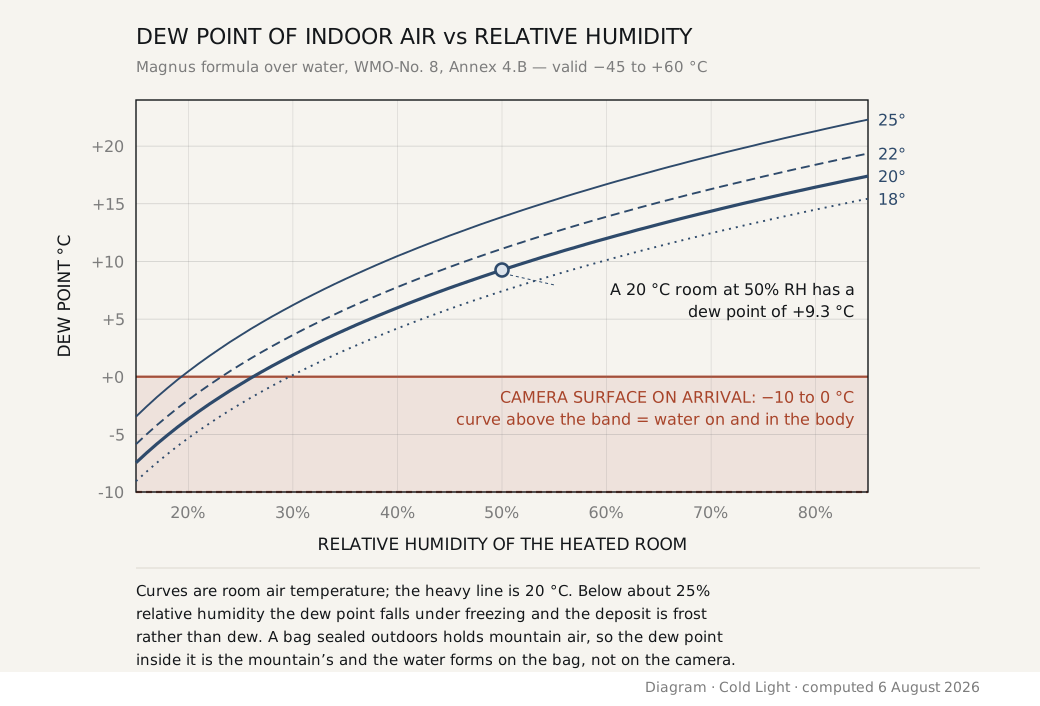
The bag does not keep water out. Sealed outdoors, it traps mountain air, whose dew point is at or below the ambient the camera has been working in, and holds that air against the body while the body warms. The water still condenses; it condenses on the outside of the bag, where it is harmless, and by the time the bag is opened the camera has crossed the room's dew point from below. Nikon frames it as a case or a plastic bag sealed before the temperature change; Sony specifies sealing the bag "to prevent air from entering" and waiting about an hour. The physics requires only that the coldest surface on the camera reach a temperature above the dew point of the air it will next meet, before it meets that air — which any sealed enclosure achieves, and so does an unheated room.
An hour is a starting figure, not a rule, and the variable is thermal mass. Kodak's technical publication Storage and Care of KODAK Photographic Materials tabulates warm-up times for film taken from storage at −18 °C to a 21 °C room: one hour for a 120 roll, an hour and a half for a 135 magazine, five hours for a 35 mm long roll. The industry has published a mass-dependent condensation table since long before sensors existed, and the ranking has not changed — a small body warms faster than a body with a grip, and a telephoto slowest of all.
The room air carried outside
The direction nobody writes about is the outbound one, and Nikon is among the few manufacturers to name it: taking a camera "from a warm to a cold environment or vice versa may cause damaging condensation inside and outside the camera". The mechanism is symmetrical. A body and lens closed up in a heated room are sealed around a small volume of that room's air, complete with its +9.3 °C dew point, and every internal surface that falls below that figure on the way up the mountain collects water on the inside, where no cloth reaches.
The scale deserves honesty. Air at 20 °C and 50 per cent relative humidity holds about 8.6 grams of water per cubic metre, so a body and lens interior of roughly 0.3 litres contains on the order of 2.6 milligrams — a computation from the same WMO relations, on an assumed internal volume. Milligrams fog a rear element or an eyepiece for a few minutes; they do not soak a camera. The reservoir that matters is what refreshes that air: each lens change on the hill, each battery door opened with a warm hand, each breath across a cold eyepiece, each cycle back into a heated cable car and out again.
A warm body in snow
Falling snow on a cold camera is dry. Falling snow on a warm one is water. A body sitting above 0 °C — one just out of a jacket, or one warming itself while recording video — melts the crystals that land on it, and liquid water can be drawn along a seam or a dial gap by capillary action in a way a dry crystal cannot. A body that has equalised with an ambient below freezing keeps snow as snow, and snow brushes off. No manufacturer manual consulted for this piece states that argument in those terms; it is offered as physics, not as documented guidance. What the manuals supply is the corollary: Canon's handling precautions for the EOS R5 Mark II say that although the camera has dust and drip resistance, "it is impossible to prevent dirt, dust, water, or salt from getting inside at all", and that "the camera is not waterproof and cannot be used underwater".
What weather-sealed actually commits to
"Weather-sealed" is a description of intent. IEC 60529, the standard behind the IP code, is a description of a test, and the two are routinely confused.
Read at the source it is narrower than its reputation. Its scope covers access to hazardous parts, ingress of solid objects and harmful effects of ingress of water — and it states that protection against external conditions including corrosion, solar radiation, icing and "moisture (for example, produced by condensation)" is a matter for the relevant product standard, not for the IP code. A first characteristic numeral of 5 means dust-protected, where "ingress of dust is not totally prevented". A second numeral of 3 means only that "water sprayed at an angle up to 60° on either side of the vertical shall have no harmful effects", verified by an oscillating tube at a mean flow of 0.07 litres per minute per hole for ten minutes. And the water tests are isothermal by construction: for IPX1 to IPX6 "the water temperature should not differ by more than 5 K from the temperature of the specimen under test". Nothing in the procedure addresses a warm enclosure meeting frozen precipitation, or a cold one meeting warm air.
Even so, the number is more than most makers offer. Ben Andrews, writing for Digital Camera World in December 2024, found that "there's only one mirrorless camera manufacturer which actually specifies a proper ingress protection (IP) rating for its high-end cameras, and that's OM System" — noting that Canon's EOS R1 listing answers "yes" to water and dust resistance, that Nikon's Z 9 copy promises "extensive weather sealing", and that Fujifilm's X-H2S offers "high levels" of resistance. Even the exception is uneven: OM System's product pages describe the OM-1 Mark II as "IP53 weatherproof — splash-proof, frost-proof and dustproof", while the company's own downloadable specification sheet for that camera carries an Environment section listing temperature and humidity and no IP figure at all.
Felderer's night on the glacier
The fifth edition of Click on the Mountain ran from 25 February to 2 March 2013, and it was won by the Italian photographer Richard Felderer with Giuliano Bordoni, Paolo Marazzi and the local rider whose name the contest's own team page spells Jacopo Thomain and the German press spells Tomain. The organisers' own announcement of the programme, dated 6 February 2013, put the proclamation of the winner on 2 March at the Jardin de l'Ange in Courmayeur; the German title skiing.de, reporting after the event, confirms only that the week closed in Courmayeur on that Saturday. Felderer described a decision taken before the week began. "The week before we got here I had phoned Giuliano and asked him what he would think about spending the night on the glaciers of Mont Blanc," runs the statement skiing.de carried in a report published on 13 March 2013, which continues that the others were immediately willing, that it was certainly no easy undertaking, and that "we had −20 °C at night".
That is a photographer's account of what he chose to do, quoted because it is the only first-hand statement about equipment temperature anywhere in this contest's record. It is not a technique and not a recommendation. Every published operating floor in the table above sits at least ten degrees above the figure Felderer gives, and the human floor is close behind it: the Wilderness Medical Society's 2024 clinical practice guidelines on frostbite, by McIntosh and colleagues in Wilderness & Environmental Medicine, describe some risk between 0 and −15 °C and increasing risk below −15 °C even at low wind speeds — and the person holding the camera has no pocket to be warmed in. Fondazione Montagna Sicura, the Courmayeur foundation whose mountain-medicine programme runs with the Azienda USL della Valle d'Aosta and whose clinic in Aosta advises those planning stays above 3,000 m, is the institution to ask about that, not a photography publication.
What the record supports is narrow. From the 2010 edition onward the contest attached an alpine guide from the Società delle Guide Alpine di Courmayeur to each team, and that is the arrangement under which the glacier ground beneath Monte Bianco was worked at all. Within it, a team met conditions in which every camera on the mountain would have been outside its published envelope, and the pictures were made anyway. The equipment was not operating to specification; it was operating outside it, on the understanding that a specification is a warranty boundary and not a physical one — and that the failure a photographer notices first, the empty battery at the top of the lift, is the one failure that was never a failure at all.
Something here wrong or incomplete? Corrections are published, dated and kept: /corrections/.